
A Social Media Strategy for Small Businesses You Can Actually Keep
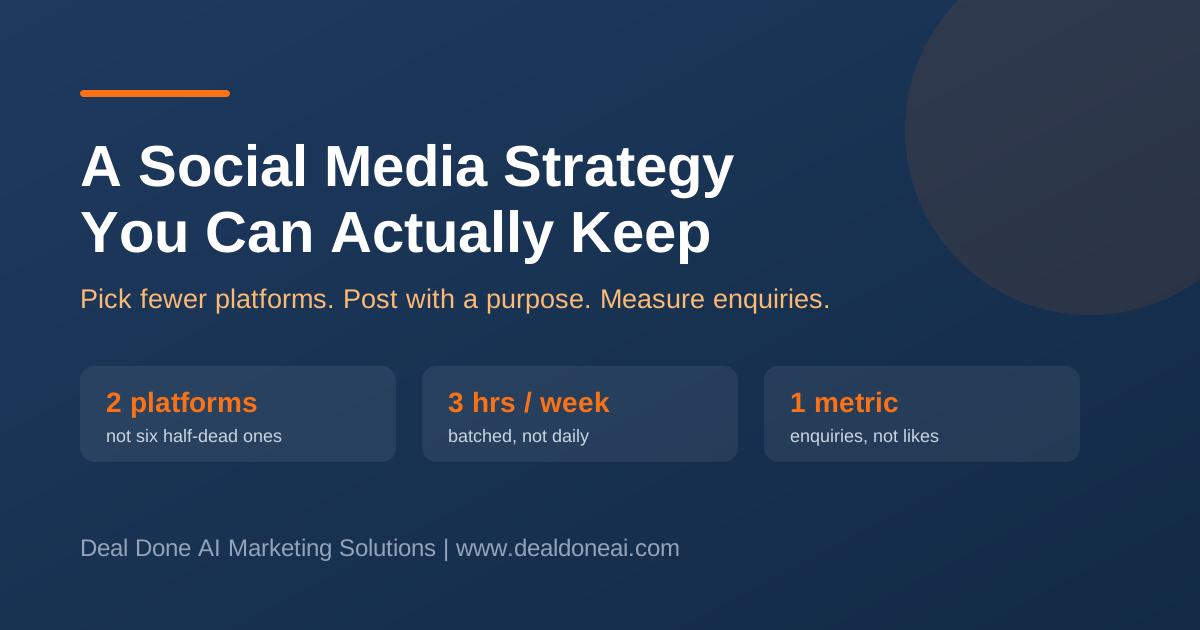
Almost every failed small business social media account failed the same way. It did not fail because the content was bad. It failed because somebody tried to run five platforms, posting daily, alone, while also running the business - and after seven weeks they stopped.
The accounts that work are usually less impressive and more boring. Two platforms. Four or five posts a week. The same person replying to messages every evening. Kept up for a year.
This guide is about building the second kind. It is deliberately about strategy rather than platform tactics - which platforms to choose, how to structure the week, what to measure and when to spend money. If you want the platform-level specifics, we have separate guides for Instagram and WhatsApp.
What's in this guide
- 1Start with the goal, not the platform
- 2Know who you are actually talking to
- 3Choose two platforms and drop the rest
- 4Give every post a job
- 5The three-hour weekly system
- 6How to never run out of things to post
- 7The numbers that predict revenue
- 8When to start spending money
- 9Mistakes that quietly kill small business accounts
- 10A worked example: a two-branch salon
- 11Frequently asked questions
Start with the goal, not the platform
The first question is never 'should we be on Instagram'. It is 'what do we need social media to do'.
There are really only four honest answers for a small business, and they lead to very different work:
Get enquiries. You need reach among people who do not know you, and a fast, obvious way to message you. Content leans towards proof and price transparency, and success is measured in DMs.
Get found by people already looking. This is mostly a search problem rather than a social one. Your Google Business Profile and your website matter more than your posting schedule.
Build trust so your existing sales process closes better. Common for higher-ticket B2B and professional services. Volume matters less; credibility, case studies and consistency matter more.
Keep existing customers coming back. This is retention, and it is usually a WhatsApp job rather than a public-feed job.
Most owners want all four and end up doing none properly. Pick the one that would change your business most in the next six months and build around it. You can add the others later.
Write the goal as a number. 'More visibility' cannot be judged. 'Twenty-five enquiries a month from social by December' can. If you cannot put a number on it, you will not be able to tell whether any of this worked.
Know who you are actually talking to
You do not need a marketing persona document. You need to be able to answer four questions about your typical buyer without guessing:
- What do they already know? A first-time buyer needs education. A trade buyer needs specifications and rates. Content written at the wrong level bores one and confuses the other
- What are they afraid of? Almost every purchase has a fear behind it - being overcharged, buying the wrong size, poor after-sales support, delays. Content that addresses the fear directly converts unusually well
- What do they compare you against? Not just competitors. Sometimes the comparison is 'do nothing' or 'do it myself'
- Where are they at 9pm? This is the practical one. It tells you which platform, and what tone
The cheapest way to answer these is to read your last fifty customer conversations. The questions people actually ask are your content plan, already written by your customers.
Choose two platforms and drop the rest
Being on six platforms with a half-dead account on each is worse than being on two properly. A dormant page with four posts from last year actively damages trust - people check, see nothing, and assume the business is struggling.
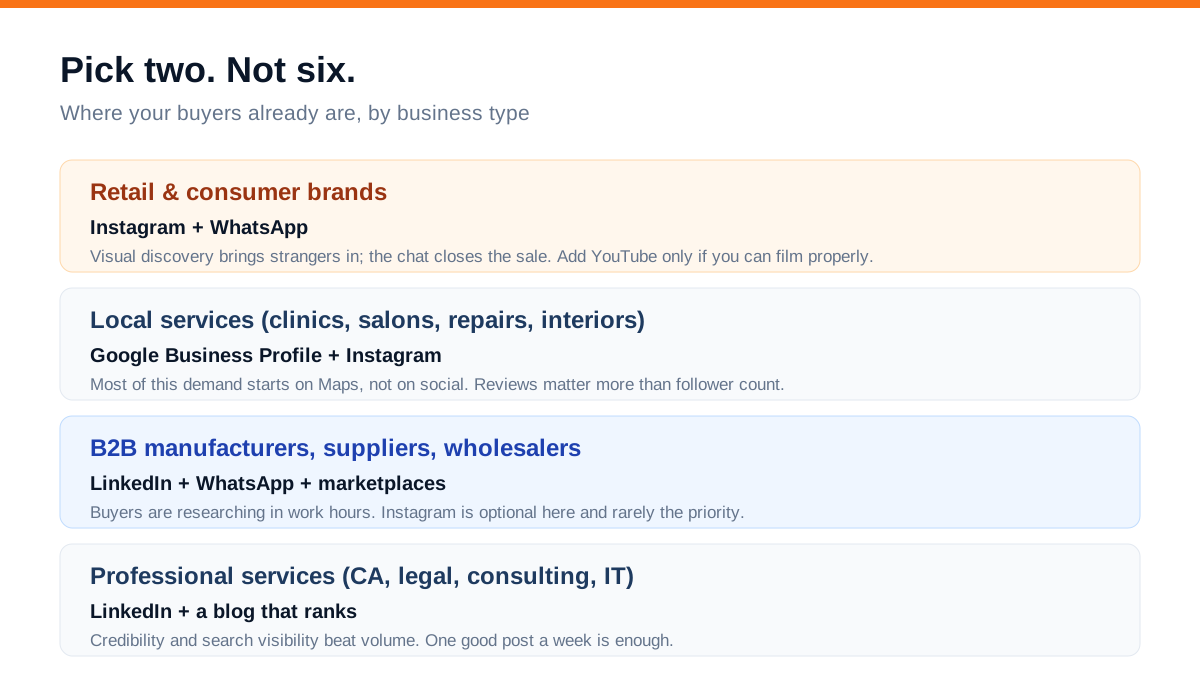
Retail and consumer brands: Instagram plus WhatsApp. Instagram brings strangers in through short video; WhatsApp closes them. Add YouTube only if you can film and edit properly, because bad video hurts more than no video.
Local services - clinics, salons, repairs, interiors: Google Business Profile plus Instagram. Most of this demand starts on Maps rather than in a feed. Reviews and photos on your profile will outperform anything you post socially, so do that first.
B2B manufacturers, suppliers, wholesalers: LinkedIn plus WhatsApp, plus the marketplaces your industry uses. Your buyers are researching during working hours in a professional frame of mind. Instagram is optional here and is rarely the priority, whatever anyone tells you.
Professional services - CA, legal, consulting, IT: LinkedIn plus a blog that ranks. Credibility and search visibility beat volume. One genuinely good post a week is enough.
Facebook still matters in smaller Indian cities and for older audiences, particularly through local groups and Marketplace. Do not dismiss it because it feels dated - check whether your buyers are there.
Whatever you choose, close or clearly park the others. A pinned post saying 'we are most active on Instagram, find us there' is better than silence.
Give every post a job
The most common content problem is not lack of ideas. It is that every post is trying to do the same vague thing: look nice and mention the business.
Assign each post one job before you make it:
- 1Teach. Explain how to choose, what things cost, what goes wrong. This is what convinces a stranger you know your work
- 2Prove. Finished jobs, before and after, a customer's words, a delivery photo. This is what turns interest into a message
- 3Humanise. Your team, your workshop, an ordinary day. Small businesses win on trust and this is where trust comes from
- 4Ask. An offer, a price, a clear instruction to message you
A rough four-three-two-one split across every ten posts works across most categories. The point is not the exact ratio. The point is that if you cannot name the job a post is doing, it probably should not be published.
One more rule: every post ends with one instruction. Not three. 'DM your city.' 'Comment RATE.' 'Save this for later.' Posts that end with a full stop get treated as decoration.
The three-hour weekly system
This is the part that determines whether you are still doing this in six months.
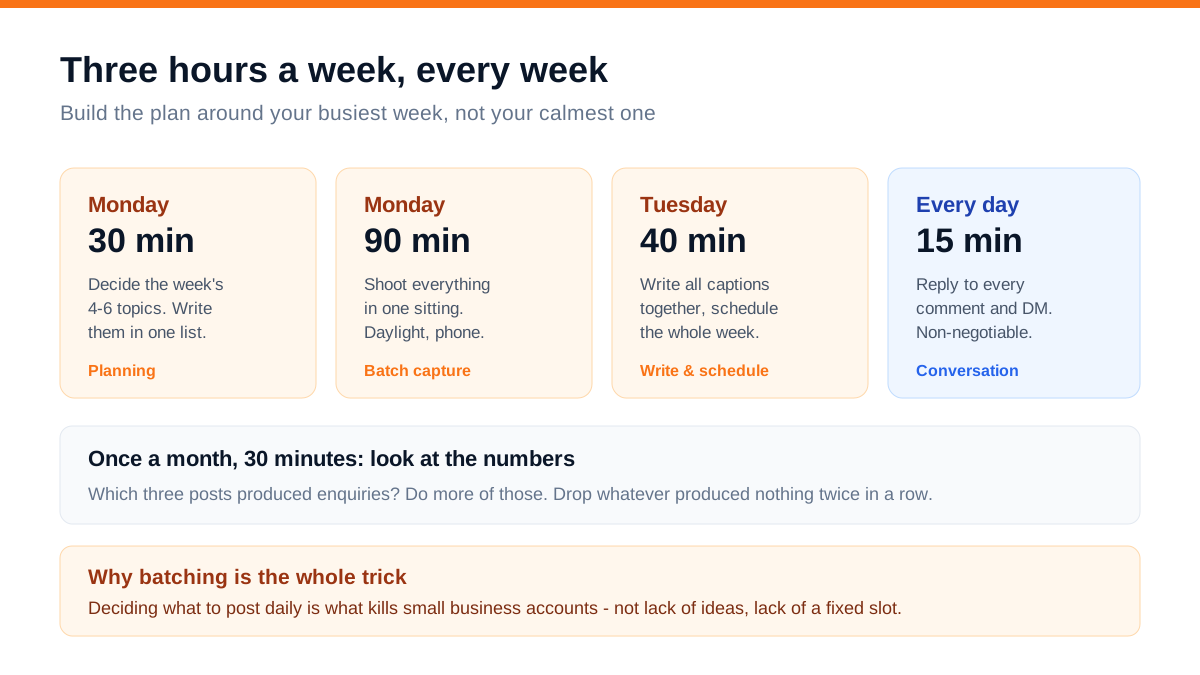
Monday, 30 minutes - plan. Decide the week's four to six topics and write them in a list. Do not create anything yet. Just decide.
Monday, 90 minutes - capture. Shoot everything for the week in one sitting. Daylight, a phone, a clear surface. Four short clips and a handful of photos. This single block is the difference between a system and a scramble.
Tuesday, 40 minutes - write and schedule. Write all the captions together, because writing five at once is far faster than writing one a day. Schedule the whole week.
Every day, 15 minutes - reply. Comments, DMs, story replies. This is non-negotiable and it is the highest-return quarter hour in the entire plan. Reach without replies produces nothing.
Once a month, 30 minutes - review. Which three posts produced enquiries? Do more of those. Which format produced nothing twice in a row? Drop it.
That is about three hours a week plus fifteen minutes a day. Build the plan around your busiest week, not your calmest one. If a plan only works when things are quiet, it does not work.
How to never run out of things to post
'I don't know what to post' is almost always a symptom of not collecting, rather than not knowing.
Keep a running list on your phone and add to it whenever these happen:
- A customer asks a question. Every question asked twice is a post. Every question asked ten times is a post you should make four different versions of
- Something goes wrong and you fix it. 'Here's what happens when the wrong adhesive is used' is more watchable than any polished promotional clip
- You finish a job. Photograph it before it leaves. You will never get that photo back later
- A supplier or price changes. Explaining why rates moved builds enormous credibility and almost nobody does it
- A season starts. Every business has a calendar - exam season, wedding season, monsoon, financial year end. Plan around yours
- You read something in your industry. Your take on it is content, and it takes ten minutes
Also reuse deliberately. A blog post becomes five posts. A long video becomes four clips. A customer testimonial becomes a graphic, a story and a caption. Small businesses do not have a content production problem so much as a content recycling problem - most of what they make gets used once and forgotten.
The numbers that predict revenue
Almost every small business tracks the wrong things, because the wrong things are the ones the app shows you first.
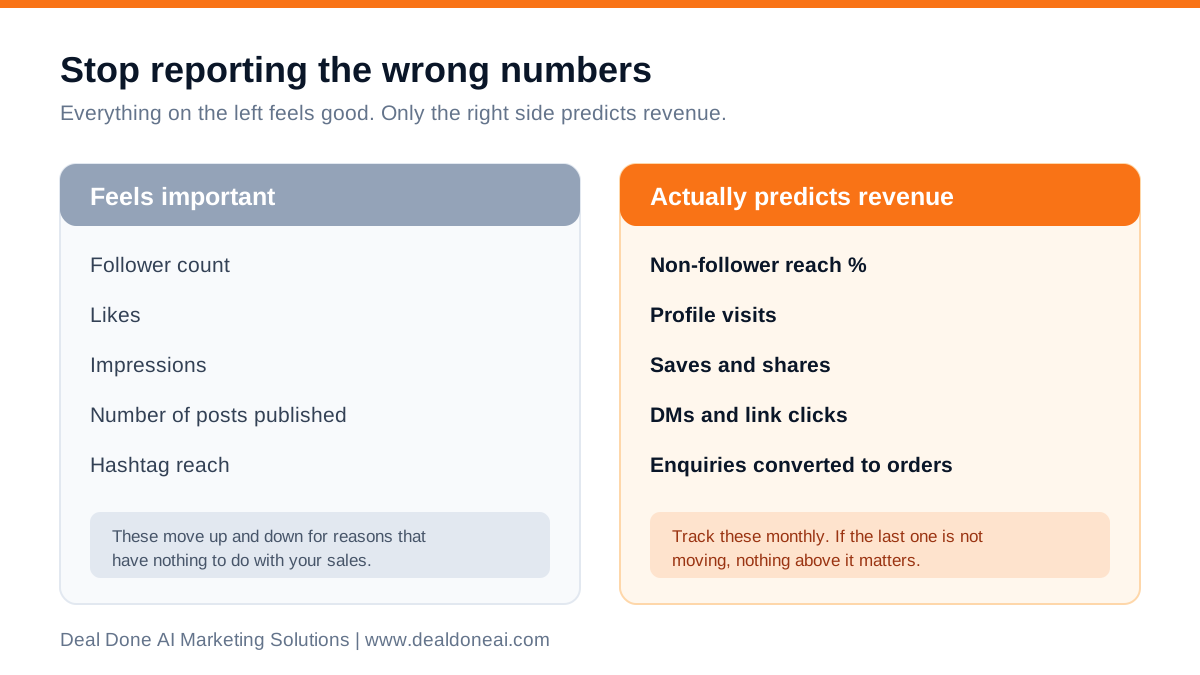
Ignore: follower count, likes, impressions, number of posts published. These move for reasons that have nothing to do with your sales, and optimising for them leads to content that performs well and sells nothing.
Track monthly:
- 1Non-follower reach as a share of total reach. If this is not growing, you are talking to the same people forever
- 2Profile visits. People who saw something and wanted to know more. This is genuine interest
- 3Saves and shares. Stronger signals than likes because they take effort, and platforms weight them accordingly
- 4DMs started and link clicks. The only numbers that touch revenue
- 5Enquiries converted to orders. Track this outside the app. If forty conversations produce one order, the problem is your reply process or your offer, not your reach
Review these monthly, not weekly. On a small account, weekly numbers are mostly noise and reacting to them will make you change strategy far too often.
When to start spending money
The right sequence is organic first, paid second - not because organic is morally superior, but because paid advertising applied to an unclear offer just buys you a faster way to waste money.
You are ready to spend when three things are true: you know which two or three pieces of content produced enquiries, you reply to messages within an hour, and you know roughly what a customer is worth to you.
When you do start:
- Put money behind content that already worked organically. You are not guessing what to advertise; the data already told you
- Start small - Rs 300 to Rs 500 a day. Enough to learn inside two weeks
- Target tightly by location first for any local business. A 15 to 25 km radius beats clever interest targeting almost every time
- Send clicks to WhatsApp or a purpose-built page, never your homepage
- Judge it on cost per genuine enquiry, not reach or clicks
If you are weighing social advertising against search advertising, the trade-off is covered properly in our Meta Ads versus Google Ads comparison - the short version is that search captures existing demand while social creates it, and most businesses eventually need both.
Mistakes that quietly kill small business accounts
- Posting only when you have something to sell. If every post is an offer, people stop looking. The nine posts that do not sell are what make the tenth work
- Copying a competitor's content. You inherit their positioning and their mistakes, and you always look like the second version
- Chasing every trend. A trending audio used badly reads as a business trying to be something it is not. Use trends only where they genuinely fit
- Being inconsistent. Twenty posts in January and nothing until April is worse than one post a week all year
- Ignoring comments and DMs. This is the most expensive mistake on the list and the easiest to fix
- Buying followers. You get an audience that never buys and an engagement rate that tanks your reach permanently
- Measuring the wrong thing and then changing strategy because of it. Six strategy changes in a year is the same as having no strategy
A worked example: a two-branch salon
A salon with two branches came to us posting daily on Instagram, Facebook and X, plus an unused YouTube channel. About 5,600 combined followers, roughly four bookings a month attributable to social, and an owner who described the whole thing as exhausting.
We cut rather than added:
- X and YouTube were parked. Facebook posts became automatic cross-posts from Instagram with no separate effort
- The Google Business Profile - which had eleven photos and no posts - became the first priority, because that is where local search demand actually lands
- Posting dropped from daily to five times a week, batched on Mondays
- Every post got a job. The ratio landed near four teach, three prove, two humanise, one offer
- Every caption ended with 'DM to book' and the DMs were answered twice daily
Over five months, follower count grew modestly - from about 5,600 to 7,900, which is not the point. Profile visits roughly tripled. Directions requests from the Google profile went from 40 a month to 210. Attributable bookings went from about 4 a month to 31. Total time spent went down, not up.
The content was not better than before. There was simply less of it, aimed at fewer places, with someone answering.
The best social media strategy for a small business is the smallest one you will still be running in twelve months.
Frequently asked questions
How many social media platforms should a small business be on?
Two, done properly, in almost every case. A third only once the first two are running without effort. Six half-maintained accounts look worse than two active ones, because a page that has not been updated in eight months tells a prospective customer that the business may not be doing well.
How often should a small business post on social media?
Three to five times a week, consistently, is the sweet spot for most small businesses. Daily posting is unnecessary and is the single most common reason owners burn out and quit. Consistency over a year beats intensity over a month, because every dormant period costs you momentum you then have to rebuild.
How long before social media brings in customers?
Expect six to eight weeks before reach and engagement patterns change meaningfully, and around three months before it shows up as enquiries and orders - assuming consistent posting and fast replies. If nothing has moved after three months of genuine consistency, the problem is usually the offer or the response process rather than the content.
Should I hire someone or do it myself?
Do it yourself for the first two or three months, even if you plan to outsource. You will learn what your audience actually responds to, and that makes you a far better client afterwards. Outsource once the time cost genuinely exceeds what the work is worth to you, or once you need production quality you cannot reach on a phone.
Is social media better than SEO for a small business?
They do different jobs. SEO captures people already searching for what you sell, which is why it tends to produce higher-intent enquiries - see our SEO playbook for how that works. Social creates awareness among people who were not looking. For most Indian small businesses the right answer is search first for intent, social second for reach, rather than choosing one.
Do I need to be on every trending platform?
No. New platforms are worth the effort only when a meaningful share of your buyers are already there. Being early on a platform your customers never adopt is pure cost. Check where your existing customers actually spend time before adding anything.
Where to start
This week, do two things. Park the platforms you are not really running, so the effort stops being spread. Then block ninety minutes on Monday in your calendar and treat it as a customer appointment.
That single recurring block is what separates the accounts that are still going next year from the ones that stopped in week seven.
If you would rather hand the whole thing over, our social media marketing service covers strategy, content, design and engagement for businesses across India, and our packages show exactly what that costs upfront. If you want an honest view on whether social is even your priority right now, talk to us - for some businesses the answer is search or WhatsApp first, and we will say so.