
How to Rank Higher on Google in 2026: A Practical SEO Playbook
SEO advice has a credibility problem. Every year brings a fresh wave of tactics that supposedly change everything, and every year the sites that actually rank are the ones doing unglamorous work consistently.
We have run search campaigns for Indian businesses for over a decade - clinics, manufacturers, coaching institutes, e-commerce brands. The pattern does not change much. What changes is how unforgiving Google has become about sites that try to shortcut the process.
This is the sequence we work through when a new client wants organic traffic that turns into enquiries. Not a list of hacks. The actual order, with the reasoning, and honest notes on how long each part takes.
Table of contents
- Start with intent, not keywords
- Fix the technical foundation
- Build topical authority
- Write pages that deserve to rank
- Get your on-page basics right
- Earn links worth having
- Win local search if you serve a city
- Optimise for AI Overviews
- Measure what matters
- Keep pages alive
- Realistic timeline
- FAQs
1. Start with intent, not a keyword list
Most SEO projects begin with a spreadsheet of keywords and search volumes. That is the wrong starting point, because volume tells you how many people search - not what they expect to find.
Google's job is to match intent. If someone types 'what is local SEO', it will show guides. If someone types 'local SEO agency Kanpur', it will show service pages. Send the wrong page type at a query and no amount of optimisation rescues it.
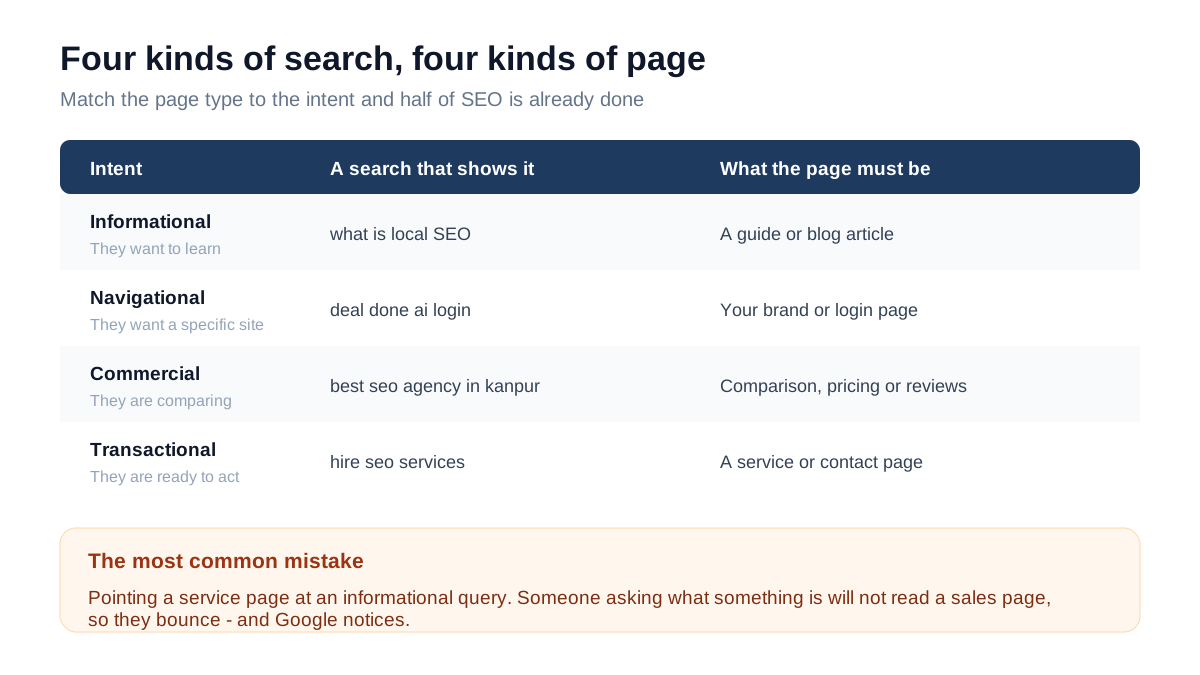
The practical exercise takes an afternoon. List every search a customer might make, sort them into the four buckets above, then decide which existing page serves each one. Two things become obvious almost immediately: you have several pages competing for the same query, and you have no page at all for some of your most valuable ones.
That gap analysis is the actual SEO plan. Everything after it is execution.
One warning worth taking seriously - do not create two pages targeting the same intent and phrase. They compete with each other, split whatever authority you have, and Google usually ranks neither well. If you already have duplicates, merge them into one stronger page and redirect the weaker URL.
2. Fix the technical foundation before writing anything
Publishing content onto a broken site is like putting new tyres on a car with a seized engine. Handle the technical layer first - it is a one-time cost that makes everything afterwards work.
The checks that matter, in the order we run them:
- Is it indexable? Open Search Console and look at the Pages report. Every 'excluded' reason is worth understanding. We regularly find sites accidentally blocking their own key pages in robots.txt, or carrying a stray noindex tag from a staging build.
- Is there one canonical version? Your site should resolve to a single address. If example.com, www.example.com, and the http versions all load separately, you have split your authority across four sites. Redirect all of them to one.
- Do old URLs still work? Any page you moved or deleted should 301 to its replacement. Dead links waste crawl budget and lose whatever authority those pages had earned.
- Is the sitemap accurate and submitted? It should list every page you want indexed and nothing you do not - no admin routes, no thank-you pages.
- Are Core Web Vitals passing? Largest Contentful Paint under 2.5 seconds, Interaction to Next Paint under 200ms, Cumulative Layout Shift under 0.1, measured on mobile.
That last one deserves emphasis for Indian sites specifically. Most traffic arrives on mid-range phones over mobile data. A page that loads in two seconds on your office wifi can take eight in a moving auto. Compressing images and cutting unused scripts usually produces the biggest single improvement - we covered the details in our guide to websites that convert.
3. Build topical authority instead of chasing single keywords
Ranking for one keyword is possible with luck. Ranking for a whole subject requires Google to see you as a credible source on it, and that is a structural thing rather than a content-volume thing.
The structure that works is a cluster: one broad pillar page covering a topic properly, surrounded by specific articles that each go deep on one sub-topic, all linking back to the pillar and sideways to each other.
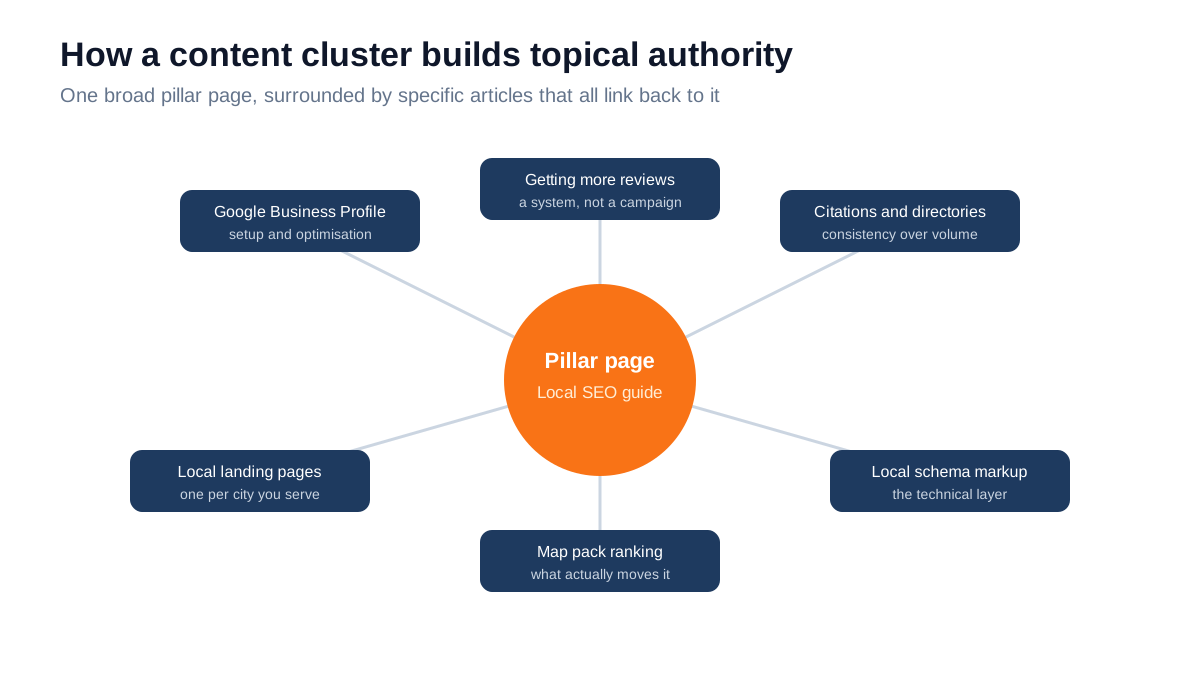
Why it works: internal links pass authority, and a tight cluster concentrates it on the page you most want to rank. It also stops you writing eight overlapping articles that fight each other - a problem we find on roughly half the sites we audit.
Start with one cluster, not five. Pick the topic closest to your highest-value service, publish the pillar, then add one supporting article every week or two. A complete cluster of six pages beats thirty scattered posts almost every time.
4. Write pages that genuinely deserve to rank
Google's helpful content systems are explicit about this: content written primarily to rank tends not to. That sounds like a platitude until you look at what separates the pages that win.
Pages that rank consistently tend to share a few traits:
- They answer the question in the first paragraph, then expand. They do not make you scroll through 400 words of preamble.
- They contain something the competition does not - real numbers, a worked example, a process nobody else published, a photograph of actual work.
- They are written by someone who has done the thing. Specifics give this away. 'Improve your page speed' is generic; 'compressing hero images from 2MB to 180KB took LCP from 4.1s to 1.9s' is experience.
- They are honest about limits. Saying when something will not work builds more trust than claiming it always does.
A test we use internally: could a competent competitor have written this page without doing the work? If yes, it is probably too generic to earn a position for anything competitive.
The bar has moved. Five years ago you needed to be relevant. Now you need to be the most useful result for that specific query, because Google has plenty of relevant options to choose from.
5. Get the on-page basics right - they still count
None of this is exciting, and all of it still matters.
- Title tag - unique on every page, primary keyword near the front, under about 60 characters so it does not truncate. This is the biggest on-page lever you have and the most commonly wasted.
- Meta description - 140 to 160 characters. Not a ranking factor directly, but it decides whether people click, and click-through affects everything downstream.
- One H1 per page that states what the page is about, followed by a logical H2 and H3 structure. Headings are how both readers and crawlers scan.
- Descriptive URLs - short, readable, keyword-bearing. Do not change existing URLs without a redirect; the cost of a broken URL usually exceeds the benefit of a prettier one.
- Image alt text that describes the image accurately. It helps accessibility, image search, and gives Google context about the page.
- Internal links with meaningful anchor text. Not 'click here'. If you link to a service page, the link text should say what that service is.
- Schema markup - Organization, LocalBusiness, Article, FAQ and Product where relevant. It will not lift you up the rankings by itself, but it makes you eligible for rich results that take up more space in the SERP.
6. Earn a few links worth having, ignore the rest
Links remain one of Google's strongest trust signals, and the market around them remains mostly rubbish.
What genuinely works for an Indian business:
- Publish something worth citing. Original data from your own operations, a genuinely thorough guide, a free tool or calculator. This is slow but the links keep arriving.
- Industry directories and associations relevant to your sector - not general link farms.
- Local relevance - chamber of commerce, local news, event sponsorships, supplier and partner pages.
- Guest articles on real publications that have their own audience, written properly rather than spun.
- Turn existing relationships into mentions. Clients, suppliers and partners frequently have a website that could reasonably link to you. Almost nobody asks.
What to avoid entirely: bulk link packages, private blog networks, comment spam, and anything advertised by volume. Rs 3,000 for 500 backlinks buys you a liability, not an asset. Recovering from a manual action takes months, and the links themselves do nothing while you wait.
Quality here is not a preference, it is arithmetic. One link from a respected industry site can outweigh several hundred directory links, and carries none of the risk.
7. Win local search if you serve a city
If customers come to you or you travel to them, local search is usually the fastest return available in the whole discipline. It sits partly outside your website, in Google Business Profile, where competition is often weak.
The short version: complete your profile fully, choose the right primary category, list every service separately, add real photos, build a steady flow of reviews, and make sure your website states your address and service areas clearly.
We wrote the full process in our local SEO and Google Business Profile playbook, and it is worth working through before spending on anything else if you are a local business.
8. Optimise for AI Overviews and zero-click results
A meaningful share of searches now end without anyone visiting a website. Google answers directly, or an AI summary does. You cannot opt out of this, so the practical response is to be the source that gets quoted.
What appears to help:
- Answer the question directly, early, in plain language. Summaries pull from clear, self-contained statements - not from paragraphs that build to a point.
- Use question-shaped headings that match how people actually ask.
- Add FAQ sections with genuine questions and complete answers. Mark them up with FAQ schema.
- Structure comparisons as tables or lists, which are easier to extract than prose.
- Be specific and factual. Vague marketing language does not get cited; concrete numbers and steps do.
There is a strategic point underneath this. If a query can be fully answered in two sentences, you will lose that click regardless of what you do - so build your content strategy around queries where someone actually needs to reach a business afterwards. Informational content still matters for authority; commercial pages are where the enquiries come from.
9. Measure the three numbers that matter
Most SEO reporting is decoration. Rankings fluctuate daily, vary by location and device, and tell you almost nothing about the business. Three numbers do.
Impressions in Search Console. This is your visibility. It moves first, often within weeks, and tells you whether Google is starting to trust the pages you published.
Clicks and click-through rate. If impressions climb but clicks do not, your titles and descriptions are the problem, not your content. That is a one-afternoon fix with an outsized effect.
Enquiries from organic traffic. The only number that pays salaries. Set up conversion tracking in Analytics with organic as a segment. Roughly a third of the accounts we audit cannot tell which channel produced their leads, which makes every budget decision a guess.
Look at all three monthly, not weekly. Weekly SEO data is mostly noise, and reacting to noise is how people undo work that was about to pay off.
10. Refresh what is already working
The highest-return SEO task is rarely a new page. It is improving one that already ranks between positions five and fifteen.
Those pages have already proved Google finds them relevant. Moving one from position eight to position three can multiply its traffic several times over, and usually takes a fraction of the effort of ranking something new.
How to do it: open Search Console, filter to pages averaging position 5-15, and for each one add the sub-topics it currently misses, update anything outdated, improve the title for click-through, and add internal links pointing to it from related articles. Then leave it alone for a month and check again.
Set a recurring reminder to do this quarterly. It is the closest thing SEO has to free traffic.
How long any of this takes
The honest answer is longer than anyone selling SEO wants to say, and the curve is not linear.
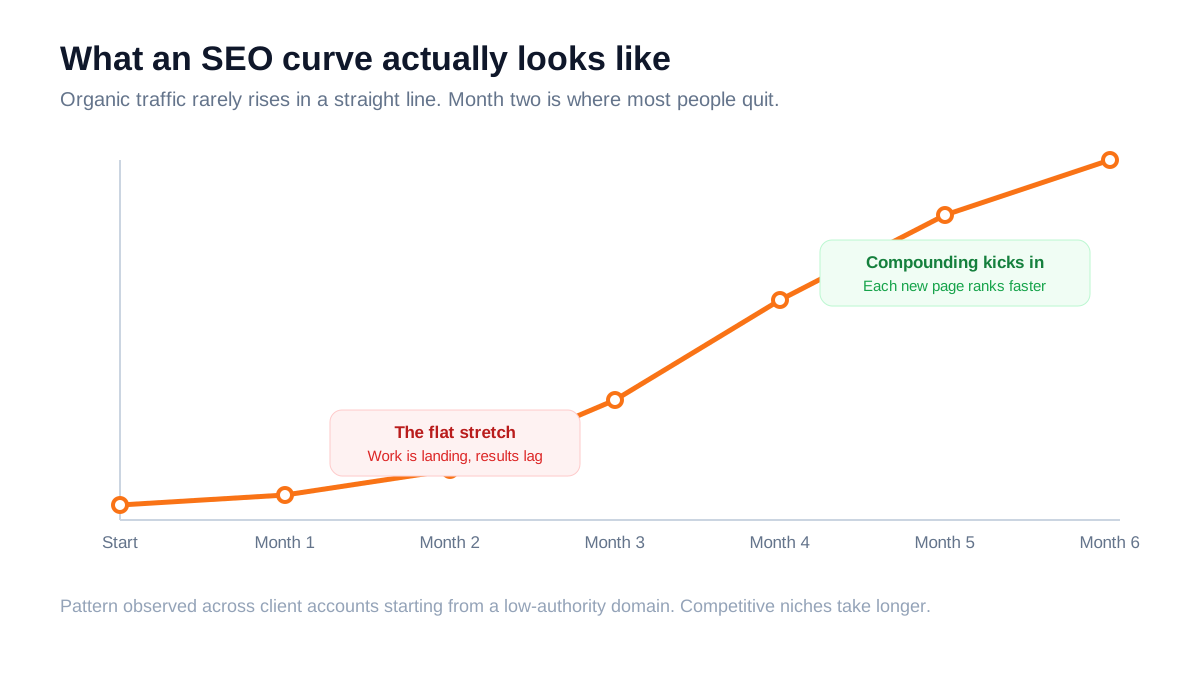
A rough guide from a low-authority domain: technical fixes can show effects within days to weeks. New content typically takes six to twelve weeks to find its position. Competitive commercial terms take four to eight months. An established domain moves considerably faster because it already has trust to spend.
What makes the difference is consistency rather than intensity. Publishing one solid page a week for six months beats publishing twenty in a burst and then stopping - Google reads the pattern, and so do the people who land on a blog whose last post is eighteen months old.
Frequently asked questions
How long does SEO take to show results in India?
Expect early movement in impressions within six to eight weeks, meaningful traffic between months three and six, and competitive commercial rankings between months four and eight. Local SEO moves faster than national SEO because the competition is usually doing less.
Is SEO still worth it with AI Overviews taking clicks?
Yes, with a shift in emphasis. Purely informational queries lose clicks to AI summaries. Commercial and local queries - where someone needs to actually contact a business - still send traffic, and those are the queries that produce revenue anyway. The response is to weight your strategy towards them, not to abandon search.
How much content do I need to publish?
Consistency beats volume. One well-researched page a week, built into a cluster, outperforms daily thin posts. If you can only manage one good article a month, do that - and spend the remaining time improving pages that already rank.
Can I do SEO myself?
The fundamentals, yes - intent mapping, on-page basics, Google Business Profile, and writing genuinely useful pages are all learnable. Technical work on larger sites, competitive link building and diagnosing ranking drops are where most people lose more time than the work is worth.
Do I need to blog to rank?
Not necessarily. A local service business can rank well on service and location pages alone. Blogging matters when you need topical authority for competitive terms, or when your customers research before buying. Do not start a blog you cannot maintain - an abandoned one signals a dormant business.
What is the single biggest SEO mistake you see?
Multiple pages targeting the same query. It happens gradually - a service page, then a blog post, then a landing page, all about the same thing. They compete, split authority, and none of them rank properly. Auditing for this and merging is often the quickest win available on an older site.
The bottom line
SEO in 2026 rewards businesses that are genuinely useful and technically sound, and it punishes shortcuts faster than it used to. There is no tactic that substitutes for matching intent, fixing your foundation, covering topics properly and earning a few good links.
If you do nothing else from this article, do two things: audit your site for pages competing with each other, and improve the pages already sitting between positions five and fifteen. Those two tasks produce more traffic per hour spent than anything else on the list.
Want this done properly?
We run this exact process for clients - technical audit, intent mapping, cluster planning, content, and the monthly work that keeps it compounding. You can see what is included and what it costs on our SEO services page, or compare complete plans on our packages page.
If you would rather get an outside opinion first, send us your website and we will tell you the three things holding it back - whether or not you work with us.