
Instagram Marketing for Indian Small Businesses: The Practical 2026 Guide
There is a particular kind of frustration we hear almost every week. A business owner has been posting on Instagram for eight months. They have 1,900 followers. Their posts get forty or fifty likes. And in eight months, Instagram has produced maybe three enquiries, two of which were people asking if the account was for sale.
The instinct at that point is to blame the algorithm. Usually the algorithm is not the problem. The problem is that the account was built like a personal profile and is being asked to behave like a shop.
This guide walks through what changes when you treat Instagram as a sales channel instead of a scrapbook. Everything here is aimed at Indian small businesses - a retailer in Kanpur, a clinic in Pune, a manufacturer in Rajkot, a service firm in Bengaluru. No influencer advice, no follower-count vanity.
What's in this guide
- 1Why most small business accounts stall
- 2Fix the profile before you post anything else
- 3The content mix that produces enquiries
- 4Reels: where new customers actually come from
- 5Writing captions that do some selling
- 6Hashtags and location in 2026: what still matters
- 7The DM is your sales floor
- 8A realistic weekly schedule you can keep
- 9The five numbers worth tracking
- 10When to spend money on Instagram
- 11A worked example: a Kanpur furniture showroom
- 12Frequently asked questions
Why most small business accounts stall
When we audit a stalled account, the same four issues show up in almost every one.
The profile does not say what the business sells. The bio is a line about passion and quality. A stranger who lands there after watching one video cannot tell in two seconds whether this business is relevant to them, so they leave.
Everything is a static photo of the product. Product photos are fine, but they mostly get shown to people who already follow you. They do not bring new people in. An account that only posts static images is essentially talking to the same 1,900 people forever.
There is no reason to message. Posts end with a full stop, not an invitation. No 'DM us for the rate list', no 'send us your city and we'll tell you delivery time'. The audience is never given a next step.
Replies take a day. Instagram DMs behave like walk-in customers. Someone standing in your shop will not wait twenty-four hours while you decide whether to talk to them, and they do not wait on Instagram either.
Fix those four and most accounts start producing enquiries within six to eight weeks - without a bigger follower count, and often without spending on ads.
Fix the profile before you post anything else
Your profile is the only page on Instagram where you control everything. Get it right once and it works for every post you publish afterwards.
Switch to a Business account. It is free, it takes two minutes, and it unlocks insights, contact buttons and ad tools. Without it you are working blind.
Use the name field as a search field. Instagram searches the name field, not the bio. 'Sharma Traders' tells the search engine nothing. 'Sharma Traders | Kitchen Ware Wholesale' tells it exactly who should see you. Put your category and, if you serve one area, your city.
Write a bio for a stranger, not for yourself. Three lines is plenty: what you sell, who you sell it to, and what to do next. 'Modular kitchens for Kanpur homes. 12 years, 800+ installs. DM your floor plan for a free quote.' That bio does more work than any tagline about excellence ever will.
Send the link somewhere useful. For most small businesses the best link is WhatsApp, because that is where the conversation is going to continue anyway. If you sell many things, link to your site's services or products page rather than the homepage.
Pin three posts. The top row of your grid is your answer to 'is this business real?'. Pin one post showing finished work, one showing prices or packages, and one showing a customer's words.
Fill in the category, address and contact buttons. If you have a physical location, this feeds the same local signals that your Google Business Profile does, and it makes the 'Call' and 'Directions' buttons appear.
The content mix that produces enquiries
The single most useful change we make to small business accounts is giving each post a job. Not 'post something today', but 'this post exists to teach, this one exists to prove, this one exists to sell'.
Out of every ten posts, this split works reliably in India across retail, services and B2B.
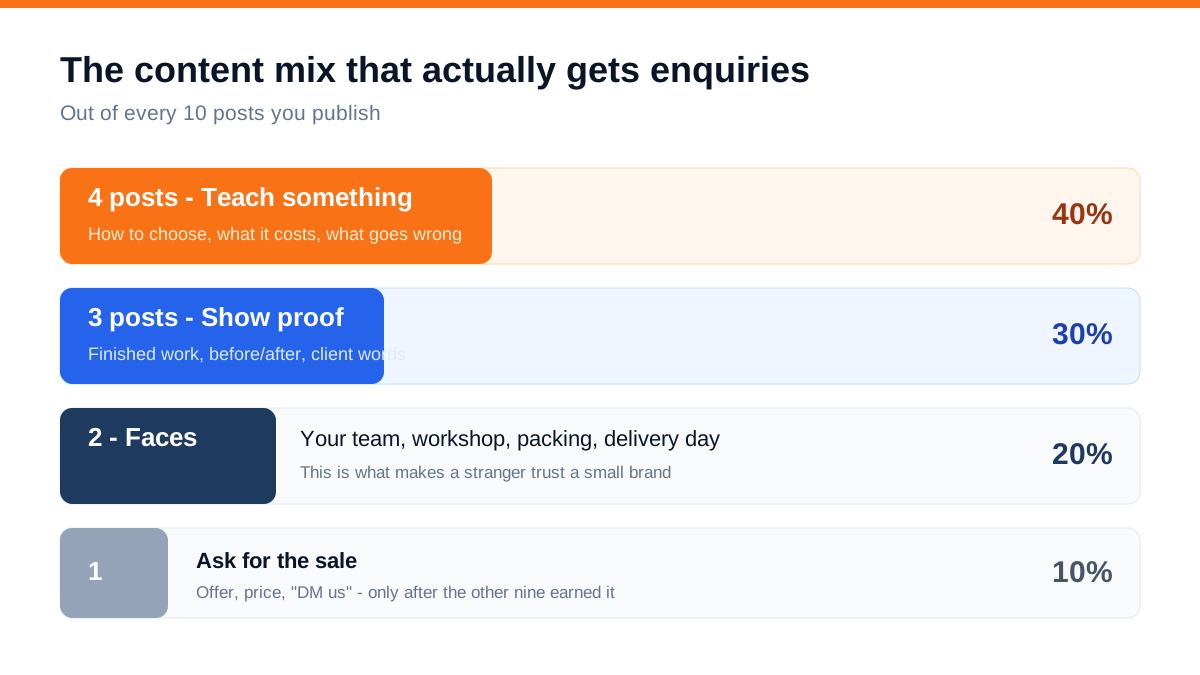
Four posts that teach. How to choose between two options. What a fair price range looks like. The three mistakes people make before buying. What the process actually involves. Teaching content is what makes strangers decide you know your work.
Three posts that prove. Finished jobs, before and after, delivery photos, a screenshot of a customer's message, a short clip of a client saying one honest sentence. Proof is the difference between 'interesting account' and 'I'll message them'.
Two posts with faces. Your team, your workshop, the packing table on a busy day, the drive to a site. Small businesses win on trust, and trust is built by looking like real people. This is the category most owners skip and it is the one that converts quietly.
One post that asks for the sale. An offer, a price, a launch, a 'DM us'. It works precisely because the other nine earned the right to ask.
If that feels like a lot, halve it. Five posts a week in the same proportion beats ten random ones.
Reels: where new customers actually come from
This is the part that changes results fastest. Static posts are shown mostly to people who already follow you. Reels are shown to people who do not.
Here is the pattern we see on a typical Indian small business account with around 2,000 followers.
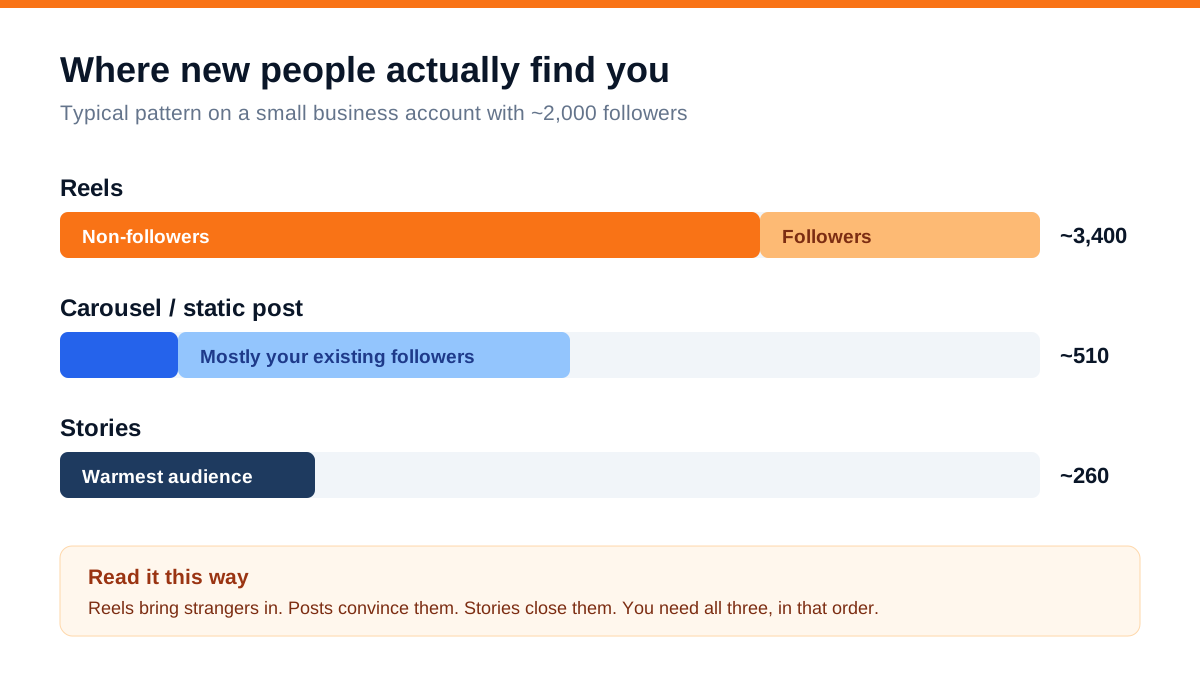
A reel on that account will often reach three to six times what a static post reaches, and the majority of that reach is people who have never heard of the business. That is the whole game. You do not grow by posting better photos for your existing followers. You grow by being shown to people who are not following you yet.
What to actually film. You do not need a camera, a studio or a script. You need a phone, daylight and one useful idea. Reel formats that work consistently for Indian small businesses:
- The one question you get asked every single day, answered in thirty seconds
- How the product is made, filmed as a quick process clip
- Before and after, with the after held on screen long enough to land
- 'Don't buy X until you check these three things' - a warning is more watchable than an advertisement
- A price breakdown. Indian buyers search for price constantly and almost nobody talks about it openly
- A day at your shop, godown or site, sped up
The first two seconds decide everything. Do not open with your logo, your name, or a slow pan. Open with the problem or the result. 'Your sofa fabric is fading in six months. Here's why.' People scroll past introductions.
Add captions. A large share of viewers watch on mute, particularly during work hours. Instagram generates captions automatically now - turn them on and correct the obvious errors.
Keep it short at first. Fifteen to thirty seconds until you can reliably hold attention. Watch time matters more than length.
Post them consistently, not perfectly. Three decent reels a week outperform one polished reel a month by a wide margin, because each reel is an independent chance at reaching new people.
Writing captions that do some selling
Most small business captions are a sentence and eleven hashtags. That is a wasted opportunity, because the caption is where someone who is already interested decides whether to message you.
A caption that works has four parts:
- 1A first line that stands alone. Instagram truncates after roughly two lines, so the opening has to earn the tap on 'more'. Make it a claim, a question or a number.
- 2Three to five short lines of substance. Explain the thing. Give the price range. Name the material. Say how long it takes. Specifics are what separate a business worth messaging from a business posting pictures.
- 3A reason to act now. Not artificial urgency - a real one. Limited stock, a seasonal window, a slot that fills up, a rate that changes with material cost.
- 4One clear instruction. 'DM your city and quantity.' 'Send us a photo of your room.' 'Comment RATE and we'll send the list.' One instruction, not three.
Write like you talk to a customer in your shop. Long formal sentences and marketing language read as distance, and distance is exactly what you are trying to close.
Hashtags and location in 2026: what still matters
Hashtags matter far less than they did five years ago, and they are no longer a growth strategy on their own. They are a categorisation signal. Instagram uses them, along with your caption text and what is visible in the video, to work out who to show your content to.
What to do now:
- Use five to ten relevant tags, not thirty. Thirty generic tags looks like spam and helps nobody
- Mix sizes: two broad (#interiordesign), three medium (#kanpurinteriors), three narrow (#modularkitchenkanpur)
- Change them per post. The same block copied everywhere tells Instagram every post is about the same thing
- Tag your location on every single post. For any business serving a city, this is worth more than the hashtags. People browse location pages, and Instagram uses location to decide who nearby should see you
- Put the important keywords in the caption itself, not only in tags. Instagram reads caption text now
The DM is your sales floor
This is the section most guides skip, and it is where the money is. Reach and likes are not the product. A conversation is the product.
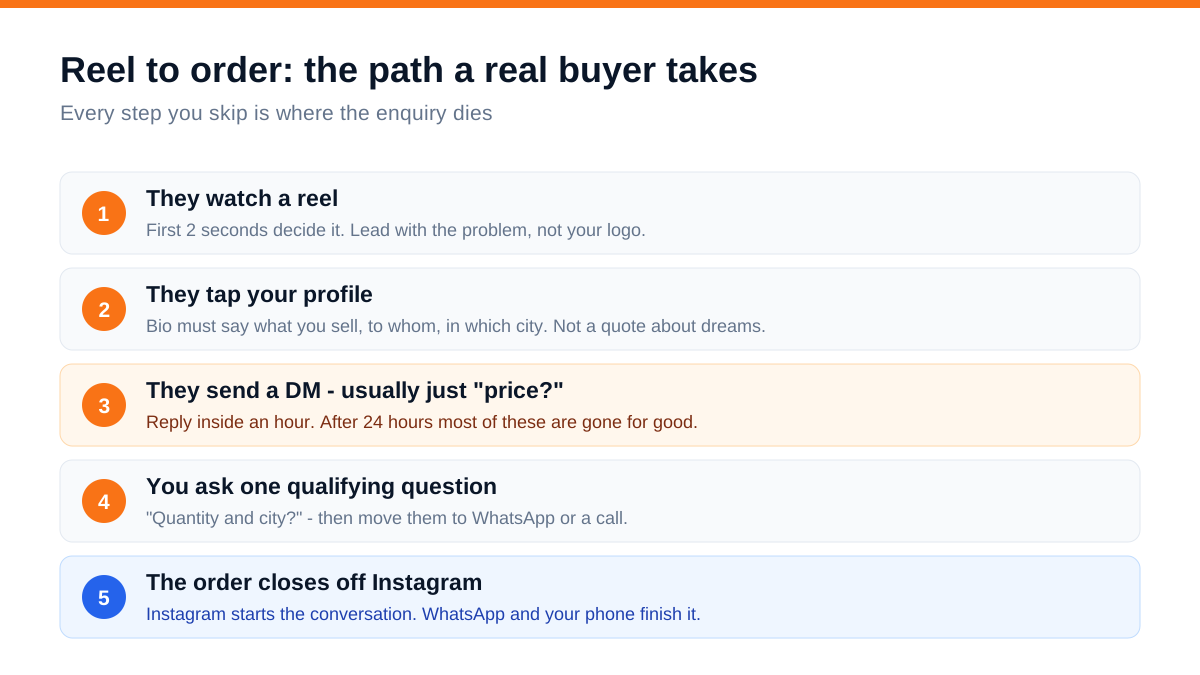
Most Instagram enquiries in India arrive as one word: 'price?'. How you handle that single word decides whether it becomes an order.
Reply within an hour during business hours. Our own data across client accounts mirrors what we see in lead generation generally - response speed is the highest-leverage variable in the entire funnel. An enquiry answered in ten minutes converts several times better than the same enquiry answered the next morning.
Do not just send a number. A bare price gives them nothing to compare and nothing to talk about. Answer with a range and one question: 'Depends on size - roughly Rs 45,000 to Rs 90,000 for a standard 8x10. What are your room dimensions?'
Ask one qualifying question, not four. Quantity and city is usually enough to know whether this is real. Four questions in the first reply feels like a form and people stop responding.
Move to WhatsApp or a call quickly. Instagram DMs are a bad place to share catalogues, quotations and payment details. Get the number, continue there. The reason WhatsApp works so well for Indian businesses is that it is where people are comfortable doing business.
Save your three most common replies. Instagram has saved replies built in. Set up a greeting, a price-range answer and a 'send me your details' message. It cuts response time enormously.
Follow up once. Someone who asked the price and went quiet is not a dead lead. One message forty-eight hours later - 'Did you get a chance to check the sizes? Happy to hold the rate this week' - recovers a meaningful share of them.
A realistic weekly schedule you can keep
The most common failure is not bad content. It is three weeks of enthusiasm followed by two months of silence. Build a schedule you can sustain on your busiest week, not your calmest one.
A workable week for a small business owner doing this themselves:
- Sunday or Monday, 90 minutes - shoot everything for the week in one sitting. Four to six clips, a handful of photos. Batching is the only reason this stays sustainable
- Monday, 30 minutes - write all the captions at once and schedule the posts
- Three reels a week - Tuesday, Thursday, Saturday works well
- Two other posts - a carousel that teaches, a proof post
- Stories on most days - unpolished, quick, from the phone. Stories are where your existing audience stays warm
- Fifteen minutes each morning and evening - reply to every comment and DM. This is non-negotiable and it is the highest-return fifteen minutes in the schedule
That is roughly three hours a week. Any plan that needs more than that will not survive a busy month.
The five numbers worth tracking
Ignore follower count. It is the number that feels most important and predicts revenue least. Open Instagram Insights and watch these instead.
- 1Reach, split by followers vs non-followers. If the non-follower share is not growing, your content is not being discovered. Post more reels
- 2Profile visits. The count of people who watched something and wanted to know more. This is genuine interest
- 3Link clicks and DM starts. The only numbers that touch revenue. Everything upstream exists to produce these
- 4Saves and shares. Instagram treats these as stronger signals than likes, because they take effort. Content that gets saved gets shown to more people
- 5Enquiries to orders. Track this outside Instagram, in a notebook or your CRM. If fifty DMs produce two orders, the problem is your reply process, not your reach
Look at these once a month, not daily. Weekly numbers on a small account are mostly noise.
When to spend money on Instagram
Do not start with ads. Ads applied to a weak profile buy you more people who bounce, and you learn nothing except that Instagram is expensive.
The right sequence is: fix the profile, publish consistently for eight weeks, find out which two or three reels actually produced DMs, and only then put money behind those. You are not guessing what to advertise at that point - the organic reach already told you.
When you do start, keep it simple:
- Boost proven reels, not new creative. A reel that already got saves and DMs organically is the safest thing you can pay to show to more people
- Target tightly by location first. For a city business, a 15 to 25 km radius around your area beats any interest-based targeting
- Start at Rs 300 to Rs 500 a day. That is enough to learn within two weeks. Anything less and the data takes too long to mean anything
- Send the click to WhatsApp, not your website, unless your site has a page built specifically to convert that traffic
- Judge it on enquiries, not reach. If Rs 15,000 in a month produced 60 conversations and 8 orders, it worked. Impressions tell you nothing
A rough benchmark from client accounts: a well-targeted local campaign on proven creative tends to land between Rs 120 and Rs 400 per genuine enquiry in most Indian consumer categories, higher for high-ticket B2B. If your first month is far outside that, the creative or the targeting is off, not the platform.
A worked example: a Kanpur furniture showroom
A showroom came to us with 2,100 followers, posting four times a week - all static product photos with a price and a phone number. Roughly two enquiries a month.
We changed four things and nothing else. No ad budget, no new equipment.
- The name field became 'Shreeji Furniture | Sofas & Beds Kanpur' and the bio named the category, the city and the delivery time
- Static posts dropped to two a week and three reels went up in their place - mostly 'how this is made', 'what this fabric actually costs', and delivery-day clips
- Every caption ended with one instruction: 'DM your room size for a quote'
- The owner's son handled DMs twice a day with three saved replies
After ninety days: followers reached about 3,400, which is not the interesting number. Non-follower reach went from roughly 18% of total to 61%. DMs went from about 6 a month to 74. Of those, 41 turned into real conversations and 11 became orders, at an average ticket of around Rs 38,000.
The content was not better looking than before. It just had a job, and someone answered the phone.
Instagram does not sell for you. It introduces you to people who did not know you existed. What you do in the next ten minutes after they message decides everything else.
Frequently asked questions
How many followers do I need before Instagram brings me business?
Fewer than you think. We regularly see accounts under 1,000 followers producing consistent enquiries, because reels are shown to non-followers regardless of your follower count. Follower count affects how many people see your stories, not how many strangers see your reels. Stop treating it as the goal.
How often should a small business post on Instagram?
Three to five times a week, with at least three of those being reels, plus stories on most days. Consistency matters far more than volume. A steady three posts a week for six months will beat two months of daily posting followed by four months of nothing, because the account never loses momentum.
Do I need to spend money on Instagram ads?
Not to start. Get the profile, content mix and DM handling right first, because ads applied to a weak profile just buy you more people who bounce. Once reels are consistently producing enquiries organically, boosting your best-performing reels to a local audience is the cheapest paid traffic most Indian small businesses can buy. If you are weighing that against search advertising, our Meta Ads vs Google Ads comparison covers where each fits.
Should I use Instagram or WhatsApp for my business?
Both, for different jobs. Instagram finds people who do not know you. WhatsApp converts and retains people who already contacted you. Trying to make Instagram do the closing, or WhatsApp do the discovery, is why one of them usually looks like it is not working.
Why did my reach suddenly drop?
Usually one of three things: you stopped posting reels, you posted several low-performing pieces in a row and the account cooled, or you posted something Instagram treats as low quality - a reposted video with another app's watermark, for example. Reach recovers within one to two weeks of returning to consistent original reels. It is rarely a penalty and almost never permanent.
How long before I see results?
Six to eight weeks to see reach and DM patterns change, three months to see it reflected in orders, assuming you post consistently and reply quickly. If nothing has moved after three months of genuine consistency, the issue is almost always the offer or the reply process rather than the posting.
Where to go from here
Pick the one thing on this page that is most obviously broken on your account and fix it this week. For most businesses that is either the bio or the reply time - both take under an hour and both change results.
Then commit to three reels a week for eight weeks. Not forever, just eight weeks. That is long enough to know whether the format works for your business, and short enough that you will actually finish it.
If you would rather not spend those three hours a week yourself, our social media marketing team handles strategy, shooting, editing, captions and DM response for businesses across India - and our packages show exactly what that costs before you talk to anyone. If you want to discuss what would work for your specific business, get in touch and we will look at your account first.