
How to Generate Quality Leads Online in India (Without Buying Lists)
Most businesses that tell us they have a lead problem do not have one. They have an enquiry problem, a follow-up problem, or a qualification problem - and those are three different things with three different fixes.
The distinction matters because the usual response to 'we need more leads' is to spend more on ads. Sometimes that is right. More often the business is already receiving enough enquiries and losing them somewhere between the form submission and the phone call.
This is the system we build for clients: where leads actually come from, how to tell a real one from noise, and the operational details that decide whether an enquiry becomes revenue.
Table of contents
- Enquiries are not leads
- Where good leads come from
- Build the capture layer
- Give people a reason to hand over details
- Qualify before you chase
- Response time beats budget
- Follow up properly
- Track the whole funnel
- FAQs
An enquiry is not a lead
An enquiry is anyone who contacted you. A lead is someone who could plausibly buy. The gap between those two numbers is where most marketing budgets quietly die.
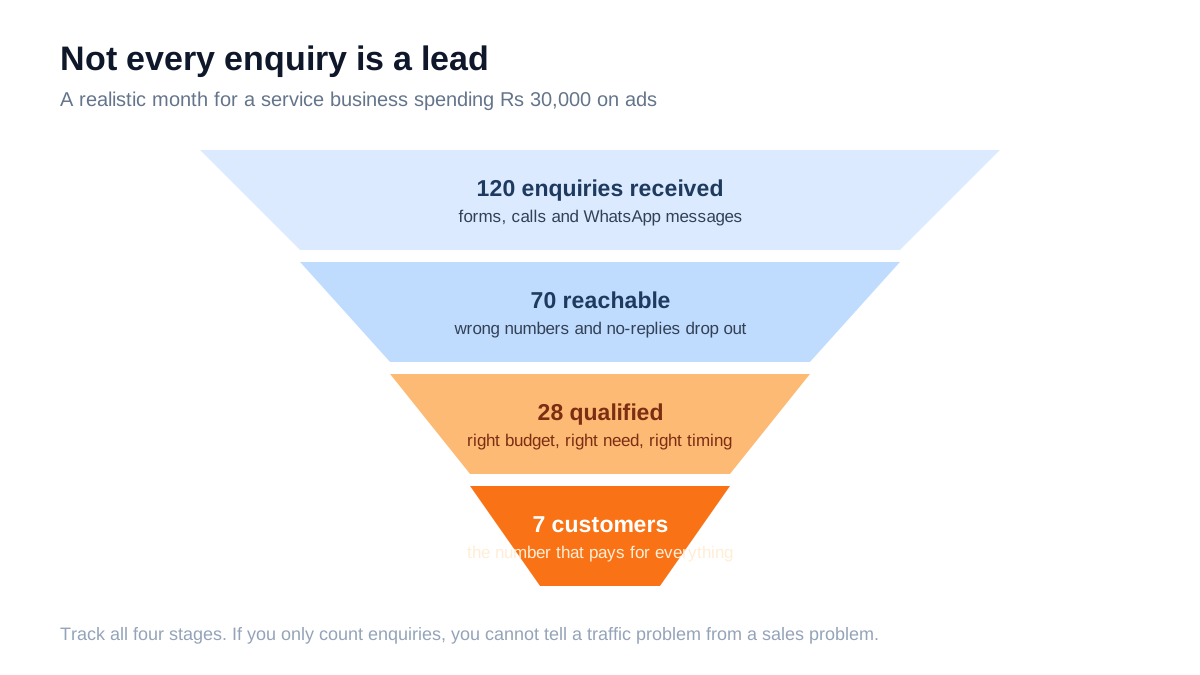
Look at that funnel carefully, because each drop-off has a different cause and a different fix.
120 to 70 - reachability. Wrong numbers, people who filled a form at midnight and vanished, tyre-kickers. Some of this is unavoidable. A lot of it comes from asking for a phone number in a way that encourages fake ones, or from ad targeting that is too broad.
70 to 28 - qualification. They picked up, but they wanted something you do not sell, or at a price you cannot meet, or in six months rather than this month. This drop-off is normal and healthy. If everyone qualifies, your targeting is probably too narrow.
28 to 7 - sales. This is not a marketing number. If you qualify 28 and close 7, the marketing did its job. If you qualify 28 and close 2, the problem is in follow-up, pricing or process - and spending more on ads will just produce more of the same.
Before increasing your budget, work out which of the three drop-offs is worst. Every rupee spent on the wrong one is wasted.
Where good leads actually come from
There is no single best channel. There is a trade-off between how much a lead costs, how good it is, and how long you wait for it.
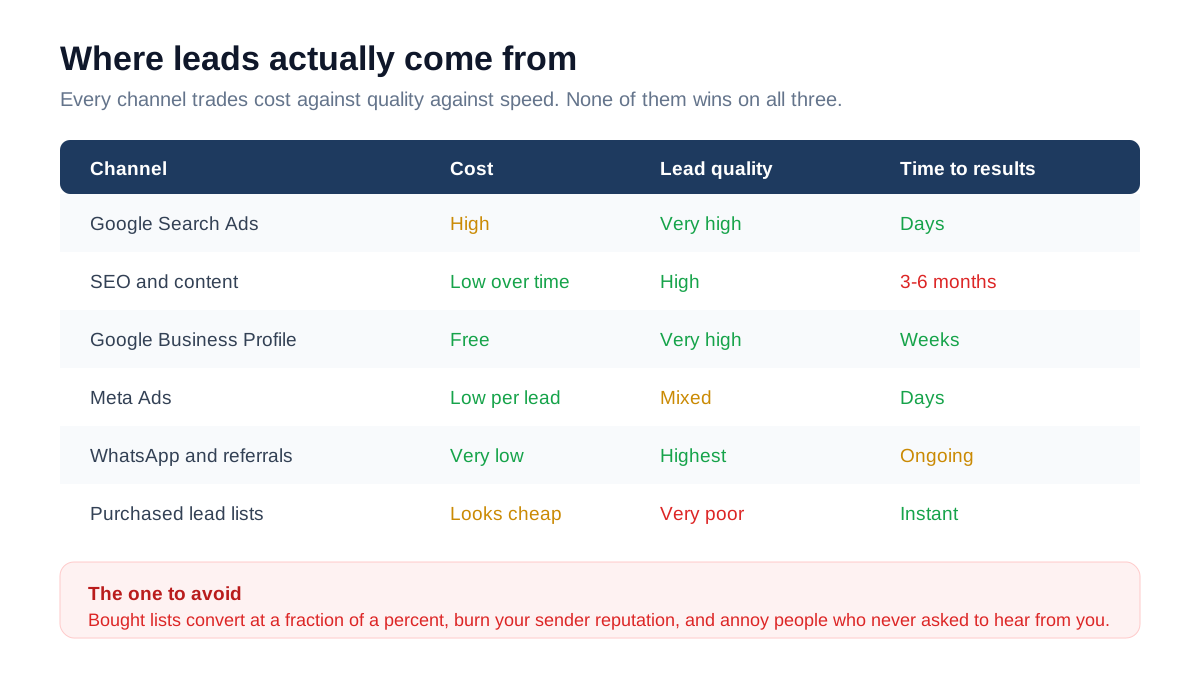
A few practical notes on each.
Google Search Ads produce the best-qualified leads for most service businesses, because the person was actively looking. They also cost the most per click. This is the channel to start with if people already search for what you sell - we covered when that is true in our Google Ads vs Meta Ads comparison.
SEO and content produce leads at almost no marginal cost once ranking, which makes them the cheapest source over a two-year view and the most expensive over a two-month one. Start it early precisely because it is slow.
Google Business Profile is the most underused free lead source in India. A complete profile with steady reviews generates calls and direction requests without any ad spend at all. If you serve a city, this should be finished before you spend a rupee on advertising - the full process is in our local SEO playbook.
Meta Ads produce cheap leads of mixed quality. Lead-form ads in particular are frictionless enough that people submit without much thought. They work well when the follow-up is fast and the offer is clear, and badly when neither is true.
Referrals and WhatsApp convert better than anything else and almost nobody systematises them. A simple habit - asking every satisfied customer for one introduction - outperforms most paid campaigns per rupee spent.
Bought lists deserve their own warning. They convert at a fraction of a percent, damage your sender reputation, and in many cases involve data the person never consented to share. We have never seen one produce a return worth the trouble.
Build a capture layer people will actually use
You can drive perfect traffic and still lose it at the point of contact. In India specifically, the businesses capturing the most enquiries do four things.
Offer WhatsApp, prominently. For most Indian audiences WhatsApp converts better than a form, because it feels like a conversation rather than a commitment - and the customer keeps the thread on their own phone. Put it in the header and repeat it after every major section.
Make the phone number tappable. It sounds trivial. We still find numbers rendered as images or plain text on roughly a third of the sites we audit, which forces mobile users to memorise and switch apps. Many simply leave.
Keep forms to three fields. Name, phone, and a one-line requirement. Every extra field costs you completions - going from three to seven can halve submissions. You are starting a conversation, not running a credit check. Ask the rest on the call.
Say what happens next. 'We reply within 4 working hours' removes the anxiety of sending your number into a void. It costs one line and measurably lifts completion.
One more thing worth checking: submit your own form and confirm the enquiry actually arrives. We audit sites regularly where the form has been silently broken for months - the owner assumed business was slow.
Give people a reason to hand over their details
'Contact us' is not an offer. It asks the visitor to take a risk with no obvious return. Most people will not.
What works is trading something concrete for the contact detail:
- A free assessment or audit - most effective for services where the customer cannot judge quality themselves. A site audit, a design consultation, a policy review.
- A price estimate or quote - powerful because pricing anxiety is the main reason people hesitate. 'Get a quote in 24 hours' converts better than 'enquire now'.
- A useful document - a checklist, a comparison guide, a specification sheet. Works best in B2B where the buyer is doing research.
- A sample or trial - a free class, a demo, a small first job at cost.
- A limited offer with a real deadline. Note the word real. Fake countdown timers that reset when you refresh are recognised instantly and cost more trust than they gain urgency.
The offer should match the temperature of the traffic. Someone who searched 'AC repair near me' wants a phone number, not an ebook. Someone reading a blog on choosing an air conditioner might take a buying guide. Matching offer to intent is the difference between a 2% and a 6% conversion rate on the same traffic.
Qualify before you chase
Not every enquiry deserves the same effort, and treating them equally is how sales teams burn out while good leads go cold.
A simple qualification framework that works without any software:
- Need - do they actually want what you sell, or something adjacent you do not offer?
- Budget - is their expectation within range of your pricing? One question usually settles it.
- Timeline - buying now, or researching for next year? Both are valid; they need different follow-up.
- Authority - are you speaking to the person who decides, particularly in B2B?
Score each enquiry hot, warm or cold within the first conversation, and treat them differently. Hot gets called immediately and quoted the same day. Warm gets a follow-up sequence. Cold goes on a list you contact once a quarter with something genuinely useful rather than a sales message.
This is also where publishing your prices pays off twice. Visible pricing filters out people who were never going to buy, so the enquiries you receive are already partly qualified. It is one reason we publish our own package pricing openly rather than hiding it behind a call.
Response time beats almost everything else
If you change one thing after reading this article, change how fast you reply.
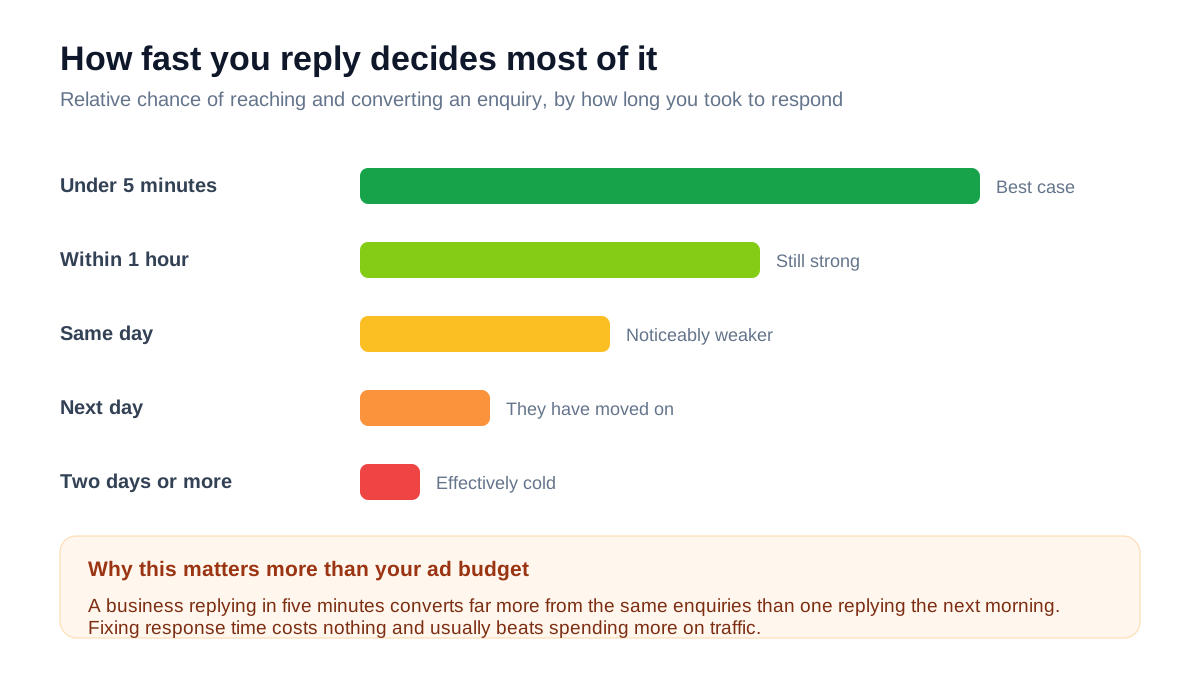
The reason is simple and slightly uncomfortable: the person who enquired with you almost certainly enquired with two or three competitors in the same ten minutes. Whoever calls first frames the conversation, and often closes it before the others have opened their inbox.
Practical ways to compress response time without hiring anyone:
- 1Route enquiries to a phone, not an inbox. Email notifications get checked twice a day. A WhatsApp or SMS alert gets seen in minutes.
- 2Send an automatic acknowledgement immediately confirming receipt and telling them when a human will call. This buys you an hour of goodwill.
- 3Assign an owner per shift. 'Someone will see it' means nobody does. One named person per time block fixes it.
- 4Have a first-call script. Three questions that qualify and one that books the next step. Most delay comes from people not knowing what to say.
- 5Log every enquiry in one place. A CRM ideally, a shared sheet at minimum. Leads sitting in one person's phone are leads nobody else can rescue.
Follow-up is where most revenue is lost
Most enquiries do not convert on first contact, and most businesses stop after one attempt. That single gap is worth more than any ad optimisation.
A sequence that works for a typical Indian service business:
- Minute 0 - automatic acknowledgement
- Under 30 minutes - first call attempt
- Same day - if unreachable, a WhatsApp message with your name, what they enquired about, and a specific question
- Day 2 - second call at a different time of day
- Day 4 - send something useful rather than a chase: a quote, a relevant example, a short guide
- Day 8 - final direct attempt, framed as closing the file
- Then quarterly - a genuinely useful message, not a sales push
Two details make this work. First, vary the channel - somebody who ignores calls may reply on WhatsApp instantly. Second, give the last message a reason to exist: 'I am closing this enquiry unless you would like me to keep it open' gets replies at a rate that surprises people.
We have seen businesses add 20-30% to their closed deals from follow-up discipline alone, with no change to traffic or budget.
Track the whole funnel, not just the top
You cannot fix what you cannot see, and most businesses only measure the first number.
Track these five monthly, on one sheet:
- 1Enquiries received, split by source
- 2Contact rate - what percentage you actually reached
- 3Qualification rate - of those reached, how many were real prospects
- 4Close rate - of qualified, how many bought
- 5Cost per closed customer, by channel
That last one is the number that should drive budget decisions, and almost nobody calculates it. A channel producing leads at Rs 200 each looks better than one at Rs 800 - until you notice the cheap channel closes at 2% and the expensive one at 18%, making the expensive channel roughly four times cheaper per customer.
This is also why we push clients to connect enquiries into a CRM rather than leaving them in an inbox or a WhatsApp thread. Once every lead carries a source and a final outcome, the arguments about which channel works simply stop - you can see it.
A worked example: same traffic, twice the customers
A furniture manufacturer near Kanpur came to us wanting more Google Ads budget. They were spending Rs 35,000 a month and closing four orders. Before touching the budget we tracked the funnel for one month.
The numbers came back like this: 96 enquiries, 41 reached, 22 qualified, 4 closed. Two things stood out immediately. They were failing to reach well over half of everyone who contacted them, and the average time between a form submission and the first call was just over nineteen hours.
We changed four things, none of which cost money.
- 1Enquiry alerts moved from email to WhatsApp, so the owner saw them on his phone within a minute.
- 2An automatic acknowledgement went out on submission, telling the customer someone would call within two hours.
- 3Anyone not reached on the first attempt got a WhatsApp message the same day and a second call the next morning.
- 4The enquiry form dropped from six fields to three, and price ranges went onto the product pages.
The following month, on the same Rs 35,000 budget: 88 enquiries - slightly fewer, because the price ranges filtered out some browsers - but 67 reached, 34 qualified, and 9 closed.
More than twice the orders from marginally less traffic. The cost per closed customer fell from about Rs 8,750 to Rs 3,900. No new channel, no extra spend, no redesign. The leads had been arriving all along; the business simply was not catching them.
Frequently asked questions
How many leads should I expect from a given budget?
It depends entirely on your industry and cost per lead. As a rough guide, a local service business spending Rs 25,000 a month on Google Ads in a tier-two Indian city typically sees 40-90 enquiries, of which perhaps a third are genuinely qualified. High-value B2B might see 10-20 enquiries for the same spend but with far higher deal values.
Are Meta lead-form ads worth using?
They produce cheap volume and mixed quality, because the form is prefilled and takes one tap. They work when you can respond within minutes and your qualification is quick. If enquiries sit unattended for a day, lead forms will feel like a waste of money - not because the channel failed, but because the follow-up did.
Should I buy leads from portals like JustDial or IndiaMART?
Portal leads can work in some categories, particularly B2B supply, but you are usually one of several vendors receiving the same enquiry simultaneously. Speed matters even more than usual. Treat them as a supplement to channels you own rather than a foundation, because you cannot control quality or volume.
How do I stop getting junk enquiries?
Three things reduce junk quickly: publish price ranges so unsuitable buyers self-select out, tighten ad targeting and negative keywords, and add one qualifying question to the form such as budget range or timeline. Adding many fields reduces junk but reduces genuine enquiries more, so add one, not five.
What is a good conversion rate from lead to customer?
It varies hugely by industry. For local services, 20-35% of qualified leads is healthy. For considered B2B purchases, 10-20%. For high-value real estate, 5-10% is normal. What matters more than the benchmark is whether your own number is improving quarter on quarter.
Do I need a CRM, or is a spreadsheet enough?
A shared spreadsheet is genuinely fine below roughly 50 enquiries a month, provided every lead is logged with source, status and next action. Past that, things start slipping through - and the moment you have more than one person following up, a CRM pays for itself in leads that do not get forgotten.
The bottom line
Lead generation is not really a traffic problem. It is a system - capture, offer, qualification, response speed, follow-up and measurement - and the weakest part of that system caps everything else.
Before you increase your budget, look at your funnel honestly. If you are reaching only half your enquiries, or replying the next morning, or dropping people after one call, fixing that will produce more customers than doubling your ad spend, and it costs nothing per month afterwards.
Then, once the system holds, spend more on whichever channel is producing the cheapest closed customer - not the cheapest lead.
Want a lead system that runs itself?
We build the whole chain for clients - the ads or SEO that bring people in, the pages and forms that capture them, and the CRM that makes sure nothing goes cold. You can see how we structure it on our lead generation service page, or compare complete plans on the packages page.
If you would rather start with a diagnosis, tell us your numbers - enquiries, contact rate and closes - and we will tell you which part of the funnel is actually costing you money.