
How to Rank in the Google Maps Pack (Including Multi-Location Businesses)
There are three slots in the Google map pack, and they collect most of the clicks for any local search. Everything below them competes for what is left.
The frustrating part for most business owners is that the results seem arbitrary. You rank first when you search from your own shop and vanish when you check from home. A competitor with worse reviews sits above you. Nothing you do seems to move it.
It is not arbitrary. Three factors decide it, one of them cannot be changed, and most businesses spend all their effort on the wrong one of the remaining two. This guide covers the mechanics - and, because it comes up constantly, how to handle service-area businesses and multiple branches.
If you are setting up local visibility for the first time, start with our local SEO and Google Business Profile guide, which covers the groundwork. This one goes into how the ranking itself works.
What's in this guide
- 1The three factors, and which ones you control
- 2Why proximity explains most of what confuses you
- 3Relevance: the fastest wins available
- 4Prominence: reviews, citations and links
- 5Storefront or service area?
- 6Structuring a multi-location business
- 7How to actually check your rankings
- 8Things that get listings suspended
- 9A 90-day plan
- 10A worked example: a three-branch diagnostics chain
- 11Frequently asked questions
The three factors, and which ones you control
Google states its local ranking factors openly, and they are more useful than most people realise.
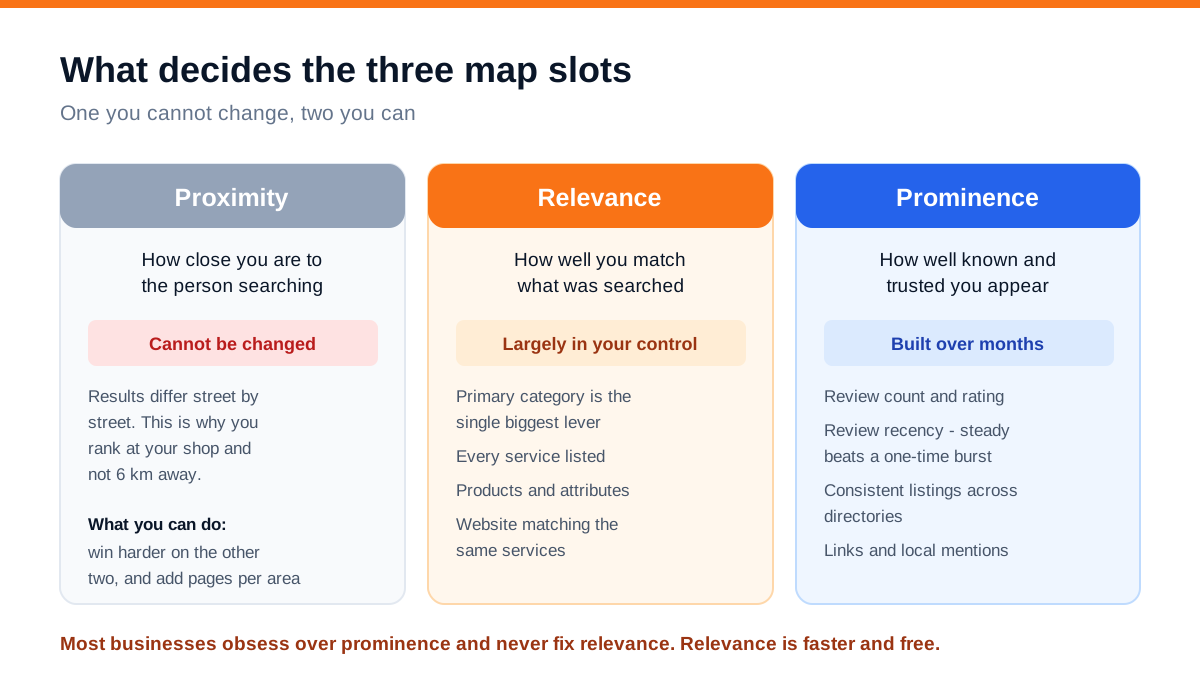
Proximity - how close you are to the person searching. You cannot change this. It is also weighted heavily, which is why results shift street by street.
Relevance - how well your listing matches what was searched. Largely within your control, and usually the fastest gain available. Primary category, services listed, products, attributes, and whether your website says the same things.
Prominence - how well known and trusted your business appears. Review count, rating, review recency, consistent listings across other directories, links and local mentions. Built over months rather than days.
The pattern we see constantly: businesses chase reviews and links while their primary category is wrong and half their services are not listed. Relevance is free, takes an hour, and often moves rankings within two weeks. Do it first.
Why proximity explains most of what confuses you
Almost every 'why do my rankings keep changing' question has the same answer.
Map results are calculated from where the searcher is standing, not from a fixed list. Search 'dentist near me' from your clinic and you are first. Search from four kilometres away and you may not appear at all. Nothing changed; the searcher moved.
This has three practical consequences.
Checking your own ranking from your shop is meaningless. You are the closest business to yourself. It tells you nothing about what customers two kilometres away see.
You cannot rank across a whole city from one address, no matter how good your listing is. A business in one corner of Kanpur will not appear for searches from the opposite corner. Anyone promising city-wide map rankings from a single location is selling something that does not exist.
The way to cover more ground is more locations or more pages, not more effort on the single listing. Genuine additional branches get their own listings. Beyond that, area-specific pages on your website can capture the ordinary organic results even where the map pack is out of reach - and those results still bring customers.
What proximity does not mean is that you should give up. It means you win by being clearly more relevant and more prominent than the businesses that are equally close, because those are the ones you are genuinely competing with.
Relevance: the fastest wins available
This is where an hour of work produces more movement than a month of anything else.
Primary category is the single biggest lever. It carries more weight than any other field. 'Dentist' and 'Dental clinic' behave differently. Look at the three businesses ranking above you, check their primary category, and consider whether yours is genuinely the closest match to what you want to be found for. Changing it is instant and free.
Add every relevant secondary category, but only genuinely relevant ones. Padding with unrelated categories dilutes rather than helps.
List every service individually. Most profiles have three services listed when the business offers fifteen. Each service entry is a chance to match a search. Write a short description for each rather than leaving them bare.
Fill in products if you sell them, with prices where you can. Product entries surface in more places than most owners expect.
Set every attribute - wheelchair access, parking, payment methods, women-led, appointment required. These feed filtered searches, and a filter you have not answered excludes you entirely.
Make your website say the same things. If your listing claims six services and your site mentions two, the signals disagree. A page per service, each naming the city, keeps them aligned.
Post regularly. Weekly updates - new work, offers, seasonal notes - are a modest signal, and they cost ten minutes.
Prominence: reviews, citations and links
Slower, but this is what separates businesses at similar distance.
Reviews matter in three ways, not one. Count, average rating, and recency. Steady flow beats a burst - twenty reviews over five months is worth considerably more than twenty in one week, which looks manufactured and can trigger filtering.
The practical system: ask every satisfied customer, at the moment the job is done, using a direct review link sent on WhatsApp. Asking in person and following up with the link converts far better than a printed QR code nobody scans.
Reply to every review, positive and negative. It is a visible signal to Google and a far more important one to the next customer reading them. A calm, specific reply to a complaint does more for your credibility than the complaint does damage.
Never buy reviews. They get filtered, and Indian businesses buying review packages is common enough that detection is good. The downside is a suspended listing.
Citations - your name, address and phone number listed consistently across directories like JustDial, IndiaMART, Sulekha and industry directories. The value is in consistency, not volume. Inconsistent details across listings actively confuse things, so fix conflicts before adding new ones.
Local links and mentions - a chamber of commerce, a supplier's dealer page, a local news mention, a sponsored event. A handful of genuine local links is worth more here than a large number of generic ones.
Storefront or service area?
This choice trips up a large share of Indian service businesses, and getting it wrong is one of the few ways to lose a listing entirely.
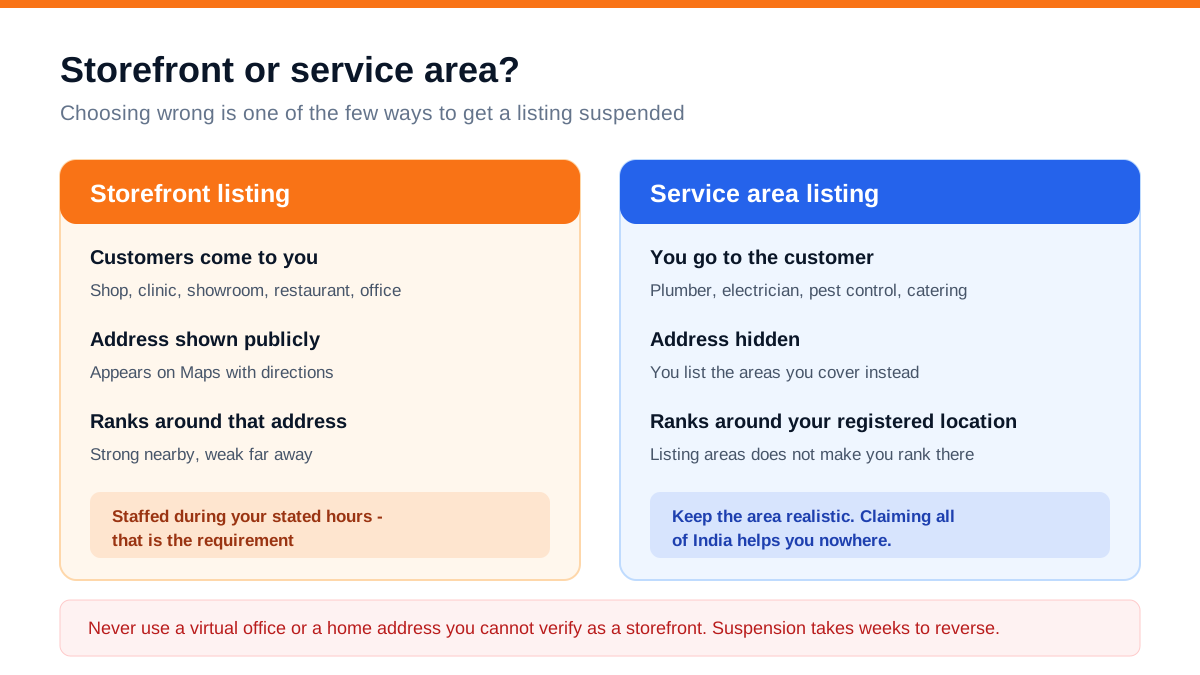
Storefront - customers come to you. A shop, clinic, showroom, restaurant or office. The address is public, the listing appears on the map, and it must be staffed during your stated hours.
Service area - you go to the customer. Plumbers, electricians, pest control, catering, mobile services. The address is hidden and you list the areas you cover instead.
Two misunderstandings cause most of the trouble:
Listing service areas does not make you rank in them. A service area business still ranks around its registered location. Adding twelve districts to the list does not put you in twelve districts' map results. Keep the area realistic - claiming all of India helps nowhere and looks implausible.
Do not fake a storefront. A virtual office, a coworking desk you do not staff, or a residential address presented as a shop will eventually be checked. Suspension takes weeks to reverse and you lose your reviews in the meantime. If you genuinely operate from home and visit customers, the service area setting exists precisely for that and is the safe choice.
Structuring a multi-location business
If you have genuine branches, each gets its own listing - and each listing needs somewhere real to point.
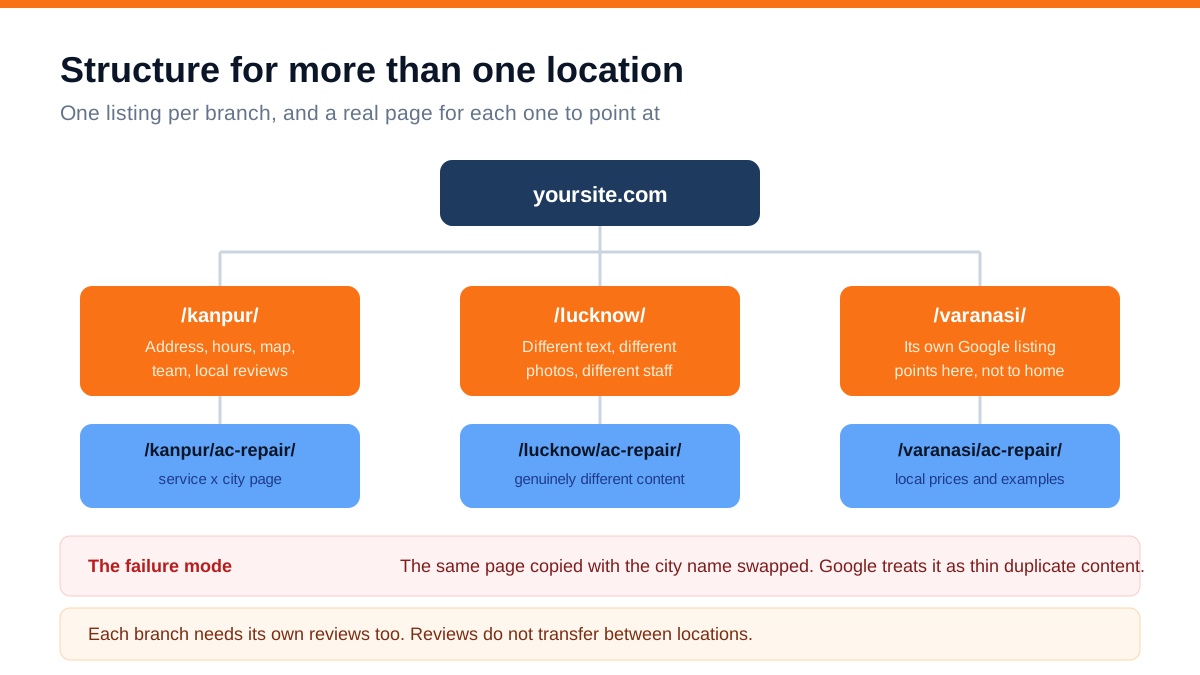
One listing per physical branch, each with its own address, phone number if possible, hours and photographs. Do not create listings for areas where you have no premises.
A dedicated landing page per branch, and the listing should link to that page rather than your home page. This is the step most businesses skip, and it costs them, because a listing pointing at a generic home page is a weaker match than one pointing at a page about that specific location.
Each branch page needs genuinely different content - its own address, map embed, hours, team, photographs, local reviews, and directions or landmarks people would actually use. The failure mode is one page copied with the city name swapped, which Google treats as thin duplicate content and largely ignores.
Service-by-city pages below that, where the volume justifies it. Again, genuinely different: local pricing, local examples, local turnaround times.
Reviews do not transfer between locations. Each branch needs its own, which means the review request has to happen at the branch, by the staff there. This is an operational habit more than a marketing task.
Keep details consistent everywhere. The same business name format across all listings and directories. Adding keywords to the business name - 'Sharma Dental Best Clinic Kanpur' - is against the rules and is a common cause of suspension, even though competitors appear to get away with it.
How to actually check your rankings
Checking on your own phone at your own premises is the most common self-deception in local SEO.
Better methods, in order of usefulness:
- 1Use the Google Business Profile performance report. How many people found you, what they searched, how many called or requested directions. This is real behaviour rather than a snapshot
- 2Check from different locations - your phone in different parts of the city, or ask a friend across town to search and screenshot. Crude but honest
- 3Use a grid-based local rank tracker if you want it systematically. These check your ranking from many points across a map and show exactly where your visibility ends. Genuinely useful for multi-location businesses
- 4Watch calls and direction requests, not positions. A rise in direction requests is worth more than a rise in a ranking you checked from your desk
Track monthly. Local rankings fluctuate constantly and weekly checking will make you change things that were working.
Things that get listings suspended
Suspension is the worst outcome here - you lose visibility and your reviews while appealing, and appeals take weeks. The common causes:
- Keywords stuffed into the business name. The most frequent cause by far
- A fake or unverifiable address, including virtual offices and unstaffed premises
- Multiple listings for the same location, often left over from an old agency
- A service area business displaying an address it should have hidden
- Bought or incentivised reviews
- Making many changes at once - address, name, category and phone number in one day looks like an account takeover
If you need to make significant changes, spread them across several weeks. And keep a photograph of your signage and a utility bill to hand; verification requests are far easier to answer when you have them ready.
A 90-day plan
Days 1-7 - relevance. Review your primary category against competitors, add secondary categories, list every service with descriptions, add products, complete every attribute, upload twenty real photographs, and set accurate hours including holidays.
Days 8-30 - alignment and reviews. Build or fix a page per location and per main service, each naming the city. Point the listing at the right page. Start the review habit: every satisfied customer, direct link, on WhatsApp, on the day.
Days 31-60 - citations. Audit your details across the directories that matter in India, fix inconsistencies, and add the ones you are missing. Keep asking for reviews weekly.
Days 61-90 - prominence and measurement. Pursue a handful of genuine local links. Post weekly on the profile. Compare your performance report against day one and decide what to repeat.
Most local businesses see meaningful movement between weeks four and ten if the relevance work in week one was done honestly.
A worked example: a three-branch diagnostics chain
A pathology and diagnostics chain with three branches in the same city. All three listings existed but all pointed to the same home page. Primary category on all three was 'Medical laboratory'. Only two services were listed. Reviews sat at 41, 12 and 6 respectively, and the smallest branch was invisible in the map pack.
The work took about six weeks:
- Primary category changed to 'Diagnostic centre' after checking what was ranking, with 'Medical laboratory' and 'Blood testing service' as secondary
- All 34 test categories listed as individual services with short descriptions and price ranges
- Three branch landing pages built, each with its own address, map, staff photographs, timings, home-collection area and directions using local landmarks. Each listing repointed to its own page
- A review habit introduced at each reception: the phlebotomist sends the review link on WhatsApp with the report
- Details corrected across seven Indian directories where the old address of one branch was still listed
After ninety days: reviews stood at 118, 74 and 61. Direction requests across the three listings went from about 310 a month to 1,240. Calls from the listings rose from roughly 190 to 640. The smallest branch, which had been invisible, was appearing in the map pack for its own neighbourhood.
The largest single jump came in week two, from the category change and the service list. Neither cost anything.
Nobody outranks proximity. You win the map pack by being obviously more relevant and more trusted than the businesses standing the same distance away.
Frequently asked questions
How do I rank higher on Google Maps?
Fix relevance first - your primary category, every service listed individually, products, attributes and a website that says the same things. Then build prominence through a steady flow of reviews, consistent listings across directories, and a few genuine local links. Proximity you cannot change, so the aim is to beat the businesses at a similar distance.
Why do my Google Maps rankings keep changing?
Because results are calculated from where each searcher is standing. You will rank first from your own premises and may not appear a few kilometres away, with nothing having changed. This is also why checking your own ranking from your shop tells you almost nothing - use the Google Business Profile performance report instead.
Can I rank on Google Maps without a physical address?
Yes, as a service area business. You hide your address and list the areas you cover instead, which is the correct setup for plumbers, electricians, pest control and similar trades. Note that listing an area does not make you rank there - a service area business still ranks around its registered location.
How many Google listings can I have?
One per genuine physical location. Creating extra listings for areas where you have no premises is against the rules and is a common cause of suspension. If you have three branches, you get three listings, each with its own address, photographs, reviews and a dedicated page on your website to link to.
How many reviews do I need to rank in the map pack?
There is no threshold. What matters is being competitive against the businesses near you, and that reviews arrive steadily rather than in bursts. Twenty reviews over five months carries more weight than twenty in one week, which can look manufactured and get filtered. Check what the three businesses ranking above you have, and aim to exceed it gradually.
Why did my Google Business Profile get suspended?
The most common causes are keywords added to the business name, an address that cannot be verified, duplicate listings for the same location, a service area business displaying its address, and bought reviews. Making several major changes on the same day can also trigger it. Appeals take weeks, so keep signage photographs and a utility bill ready.
Where to start
Open your Google Business Profile today and look at two things: your primary category, and how many services are listed. For most businesses, those two fields are wrong or half-empty, and fixing them takes under an hour with no cost.
Then set up the review habit. Not a campaign - a habit, attached to the moment a job finishes, using a direct link on WhatsApp. Everything else in local SEO is easier once that is running.
Our Google Business Profile service covers setup, category and service optimisation, review systems and multi-location structure, and our local SEO work extends it to the website side. The packages page lists what each includes. If you want to know why a particular competitor is outranking you, send us both business names and we will look at what is actually different.