
Does Your Business Actually Need a Website in 2026? An Honest Answer
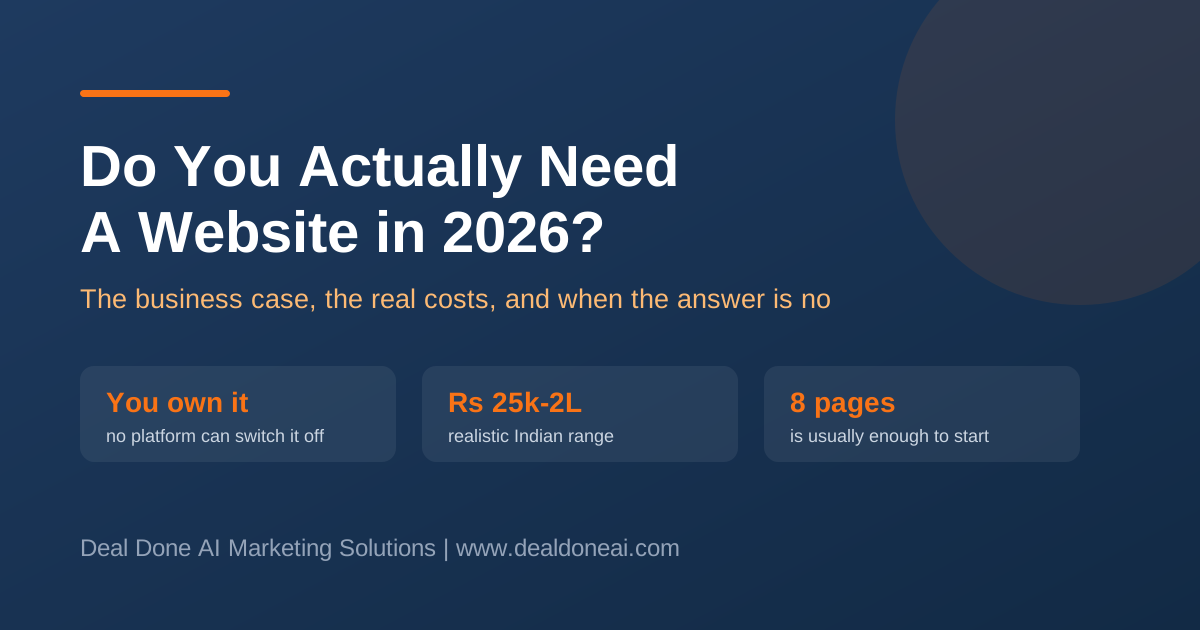
Plenty of Indian businesses run perfectly well on a WhatsApp number, an Instagram page and word of mouth. If someone tells you a website is compulsory for every business, they are selling websites.
But there is a point in most businesses where the absence of one starts costing real money, and it usually arrives quietly. A large buyer asks for your website before placing an order. A customer searches for what you sell and finds three competitors. An Instagram account gets locked for four days and the enquiries stop dead.
This guide is about working out whether you are at that point, what a website should actually contain, what it honestly costs in India, and the cases where the money is better spent elsewhere.
What's in this guide
- 1The real argument: owning versus renting
- 2What a website does that social media cannot
- 3The eight pages you actually need
- 4What it costs in India, honestly
- 5Why cheap websites cost more
- 6What to insist on before you pay
- 7Questions to ask any web developer
- 8When you genuinely do not need one yet
- 9Signs the site you already have is holding you back
- 10A worked example: an industrial fabricator
- 11Frequently asked questions
The real argument: owning versus renting
Most articles argue that a website makes you look professional. True, but weak - plenty of informal businesses do very well.
The stronger argument is about control.
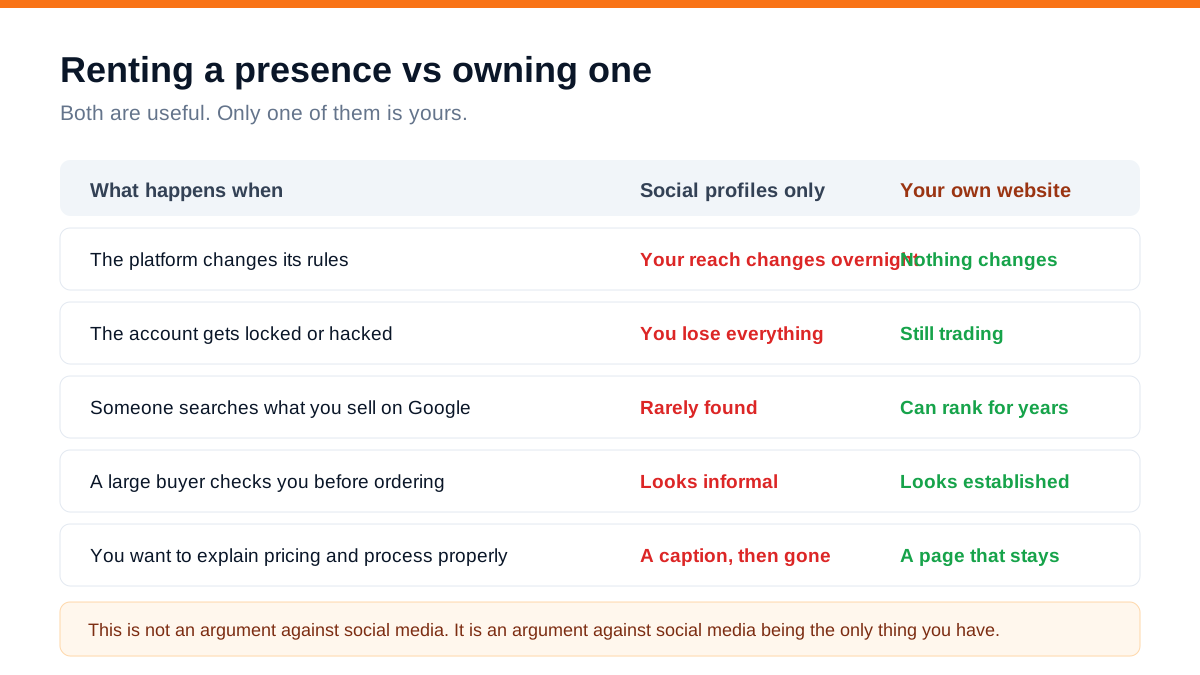
Every platform you rely on is rented. Instagram decides who sees your posts and changes that decision regularly. A marketplace can suspend your listing. An account can be hacked or locked, and appeals take days. We have watched a business lose a five-year-old Instagram account and, with it, its entire customer contact list.
A website does not have a reach algorithm. It does not get locked because of an automated flag. It does not change its rules and halve your visibility in a quarter. It sits there and works.
That is the whole argument, and it becomes more important the more the business depends on online enquiries. If social media disappearing tomorrow would be inconvenient, you are fine. If it would be catastrophic, you have a structural problem that no amount of posting fixes.
What a website does that social media cannot
Beyond ownership, there are five practical jobs a website does that a social profile genuinely cannot.
It gets found by people searching. Somebody typing 'MS fabrication work in Kanpur' into Google is ready to buy. That search almost never surfaces an Instagram profile. It surfaces websites and Google Business listings. This is the largest missed opportunity for most Indian small businesses - demand that already exists, going to whoever has a page for it.
It explains things properly. A caption cannot carry your process, your pricing structure, your specifications, your warranty terms and your delivery timelines. A page can, and it stays there permanently rather than scrolling away in a day.
It works while you sleep. Enquiry forms and WhatsApp buttons collect enquiries at 11pm and on holidays.
It carries weight with serious buyers. For B2B, institutional and higher-value purchases, a buyer checking you out before committing is normal. A proper website reads as an established business. Its absence raises a question you never get to answer.
It makes everything else cheaper. Advertising sent to a good website converts better than the same advertising sent to a social profile, which means your cost per customer falls across every channel. This is why building the site before scaling ad spend is the right order, and doing it the other way round wastes money for months.
The eight pages you actually need
A common reason businesses delay is imagining a large project. It is not. Eight pages is a complete website for most small businesses.
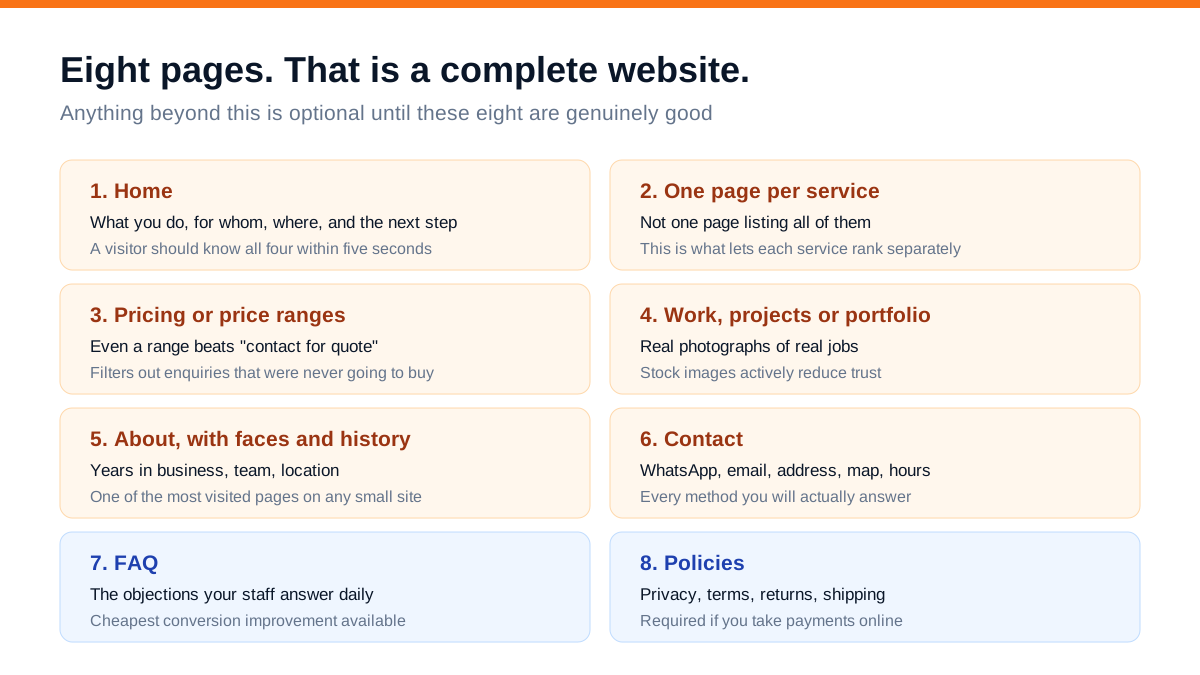
Two of these deserve emphasis because they are where most sites fail.
One page per service, not one page listing all of them. A single 'Services' page with eight paragraphs cannot rank for eight different searches. Eight separate pages can. This one structural decision does more for search visibility than almost anything else on a small business site.
Pricing, or at least ranges. Indian buyers search for price constantly, and 'contact us for a quote' loses to any competitor willing to publish a number. A range with an explanation of what moves it - 'Rs 45,000 to Rs 90,000 depending on size and finish' - filters out people who were never going to buy and pre-qualifies the ones who do enquire.
The rest are straightforward: a home page that says what you do, for whom and where within five seconds; real photographs of real work rather than stock images; an about page with faces and history, which is one of the most-visited pages on any small business site; a contact page listing every method you will actually answer; an FAQ covering the objections your staff handle daily; and policies, which are required if you take payments online.
What it costs in India, honestly
Prices vary enormously and most quotes are not comparable because they include different things.
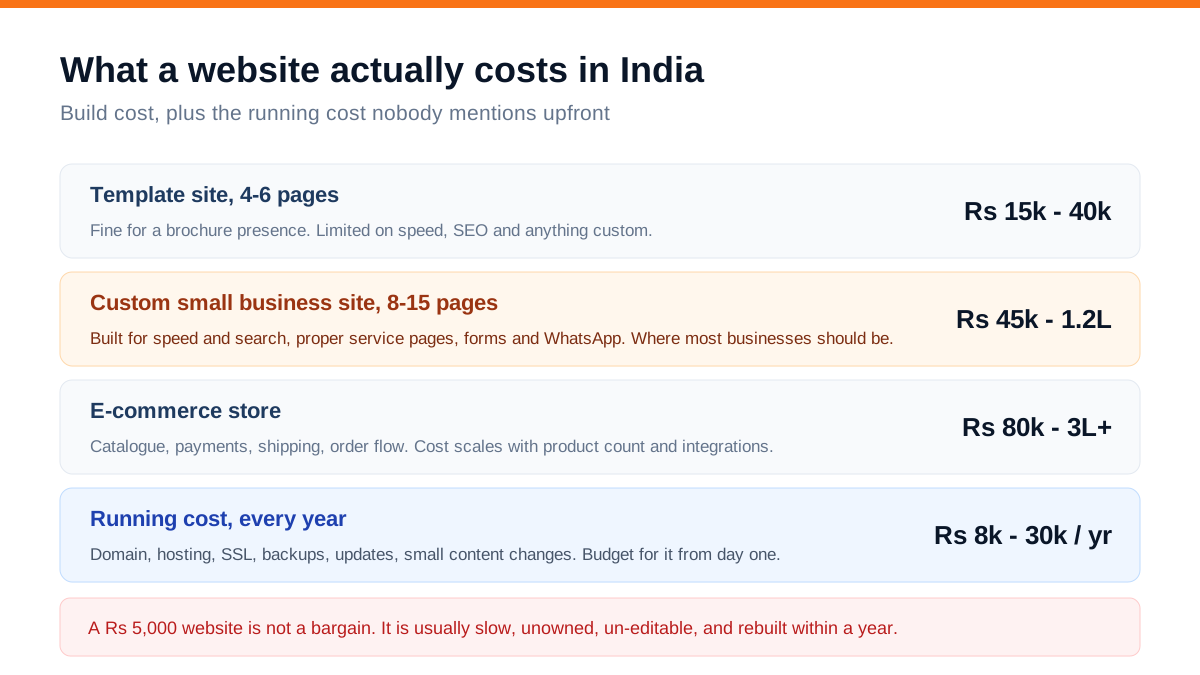
Template site, four to six pages - Rs 15,000 to Rs 40,000. Fine as a brochure presence. Limited on speed, on search, and on anything specific to your business.
Custom small business site, eight to fifteen pages - Rs 45,000 to Rs 1,20,000. Built for speed and search, with proper service pages, working forms and WhatsApp integration. This is where most Indian small businesses should be.
E-commerce store - Rs 80,000 to Rs 3,00,000 and upwards, scaling with product count, payment and shipping integrations.
Running costs - Rs 8,000 to Rs 30,000 a year for domain, hosting, SSL, backups, updates and small content changes. Budget for this from the start; a site nobody maintains degrades within eighteen months.
A note on how to think about the spend: compare it against what one customer is worth to you. If your average order is Rs 40,000 at a healthy margin, a Rs 70,000 website that brings four extra customers in its first year has paid for itself and everything after that is profit. That framing is more useful than comparing quotes against each other, and it is covered further in our guide to digital marketing ROI.
Why cheap websites cost more
There is always someone offering a website for Rs 5,000. There are four reliable reasons it ends up more expensive.
It is slow. Cheap builds are usually a heavy theme plus fifteen plugins on shared hosting. It loads in eight seconds on a phone, and most visitors never see it. You then pay for advertising traffic that bounces before the page appears.
It cannot rank. No structure, one page for all services, no meta descriptions, no schema, no logical URLs. It exists and is invisible.
You do not own it. No access to the domain registrar, no hosting login, no source files. When you want to move or change developer, you rebuild from scratch. Ask for these credentials before paying, not after.
Nobody can edit it. Every small change means going back to the developer, who eventually stops responding. The site freezes, ages, and starts working against you.
The pattern is consistent: the cheap site is rebuilt within twelve to eighteen months, so the true cost was the cheap build plus the real one plus a year of lost enquiries.
What to insist on before you pay
Whoever builds it, these are not optional in 2026.
- Genuinely mobile-first. Most of your visitors are on a phone. Test on a real mid-range Android on mobile data, not on a desktop browser resized - the difference is covered properly in our mobile-first guide
- Fast. Main content visible in under 2.5 seconds on mobile, no layout jumping as things load
- A separate page per service, each with its own title and description
- HTTPS, working forms that actually deliver to an inbox you check, and a WhatsApp button
- Google Analytics and Search Console connected from day one, so you can tell whether anything is working
- An XML sitemap and clean URLs
- Content you can edit yourself without calling anyone
- All credentials handed over in writing - domain registrar, hosting, CMS admin
If a quote does not mention speed, mobile or search at all, it is a design job rather than a marketing asset, and it will need redoing.
Questions to ask any web developer
Six questions that separate a serious builder from an order-taker:
- 1Who will own the domain and hosting accounts? The only acceptable answer is you
- 2What will the mobile load time be, and how will you demonstrate it?
- 3How many pages, and how are services structured? If the answer is one services page, ask why
- 4What is included after launch, and what does it cost annually?
- 5Can I edit text and images myself? Ask for a demonstration, not a yes
- 6Can I see two sites you built that are more than a year old? Sites age badly when built badly, and a year is long enough to show it
When you genuinely do not need one yet
Being straight about this matters. Skip or postpone the website if:
All your business comes from a marketplace and always will. If you sell entirely through a platform and have no intention of building direct customers, a website adds little. Though this is also exactly the dependency risk described earlier.
You are testing whether the business works at all. In the first few months, spend on finding out whether people will pay you. A WhatsApp number and an Instagram page are enough to learn that.
Your enquiries all come from personal relationships. Some trades run entirely on referral. A website helps at the margin, but it is not urgent.
Your Google Business Profile is incomplete. For any local business, finish that first. It is free, it takes an afternoon, and it produces enquiries faster than a website will. Only then build the site.
You cannot afford to do it properly. Waiting three months and building something good beats spending Rs 8,000 now on something you will replace.
Signs the site you already have is holding you back
Many businesses do not need a first website - they need to admit the current one is not working. The signals:
- It takes more than four seconds to load on a phone on mobile data
- You have to pinch and zoom to read anything on it
- It has one page covering every service
- Nothing has been changed in over two years
- The contact form does not deliver, or nobody knows which inbox it goes to
- It shows a security warning, or is still on HTTP
- You are embarrassed to send the link to a serious buyer
Three or more of these and a rebuild will usually pay for itself faster than any advertising you could buy with the same money.
A worked example: an industrial fabricator
A fabrication workshop with eleven years of trading came to us with no website at all. Everything ran through references and a WhatsApp number. Revenue was steady at roughly Rs 40 lakh a year, but flat for three years, and two large enquiries had recently gone elsewhere after the buyer asked for a website and company profile.
We built an eleven-page site: home, six separate service pages, projects, about, contact, and an FAQ. Real photographs from the workshop, indicative price ranges per service, specifications, and a WhatsApp button on every page. The Google Business Profile was completed at the same time, with photos and services listed.
For the first two months, almost nothing happened - which is normal, and worth expecting.
By month five the site was ranking for several 'fabrication in [city]' variations and producing 14 to 20 enquiries a month, mostly through the individual service pages rather than the home page. By month ten, revenue was around Rs 71 lakh annualised, and two of the year's largest orders came from buyers who had found the site, read the projects page, and called.
The owner's own summary was the useful part: the site did not create demand that did not exist. It let him be found by demand that was already there and had been going to competitors for three years.
The question is not whether a website looks professional. It is whether the demand already searching for what you sell can find you, and whether you own the place they land.
Frequently asked questions
How much does a business website cost in India?
A template site of four to six pages typically runs Rs 15,000 to Rs 40,000. A custom small business site of eight to fifteen pages, built for speed and search, generally costs Rs 45,000 to Rs 1,20,000. E-commerce starts around Rs 80,000 and rises with catalogue size and integrations. Add Rs 8,000 to Rs 30,000 a year for domain, hosting, backups and maintenance.
Is a website still necessary if I have Instagram and WhatsApp?
It depends on how much you depend on online enquiries. Social and WhatsApp are excellent at conversation and conversion, but they are rented - reach, rules and account access are not yours. A website is the only part you own, and it is the only one that appears when someone searches on Google for what you sell.
How long does it take to build a business website?
Two to four weeks for a straightforward small business site, four to eight for something larger or e-commerce. The usual delay is not development - it is waiting for content, photographs and approvals from the business. Gathering your text, images and pricing before the project starts typically halves the timeline.
Should I use Wix, WordPress or a custom build?
Site builders are fine for a simple brochure presence and let you make changes yourself. WordPress is the common middle ground and handles most small business needs well. Custom builds make sense when speed, search performance or specific functionality genuinely matter to the business. The platform matters far less than whether the site is fast, structured for search, and owned by you.
Will a website bring me customers on its own?
Not by itself. A website is where enquiries convert; something has to send people to it - search, advertising, your Google Business Profile, social, or your existing contacts. Businesses that build a site and then wait are usually disappointed. Businesses that build a site and then point traffic at it see the return.
How often should a website be updated?
Small content updates monthly - new work, new photographs, updated prices. A technical review annually for speed, security and broken links. A full redesign every three to five years, or sooner if the signals in this guide apply. A site that has not been touched in two years actively reduces trust with anyone who checks.
Where to start
If you have no site: complete your Google Business Profile this week, because it is free and it works faster. Then write down your eight pages and the text for each. That document is 70% of the project, and it is the part that usually stalls it.
If you have a site: open it on your phone on mobile data and time it. If the main content is not visible within about three seconds, that is your first problem, and it is costing you every visitor you currently pay to acquire.
Our website development service covers builds designed for speed and search rather than only appearance, and the packages page shows what each level includes and costs. If you want an honest opinion on whether you need a new site or just fixes to the current one, send us the link - the answer is 'just fixes' more often than you would expect us to say.