
The Real ROI of Digital Marketing for a Small Business (With Numbers)
'Is digital marketing actually worth it?' is a fair question and it usually gets a bad answer. Agencies quote industry averages. Blogs quote studies from other countries. Neither tells a business owner in Kanpur or Coimbatore whether their Rs 40,000 a month is doing anything.
The honest answer is that digital marketing has enormous ROI for some businesses and none at all for others, and the difference is almost never the platform. It is whether the business knows two numbers, picked channels that match its timeline, and fixed the leaks between spend and revenue.
This guide is about working that out for yourself, with arithmetic you can do on paper.
What's in this guide
- 1Why most ROI numbers are useless
- 2The two numbers that decide everything
- 3How to actually calculate your ROI
- 4Realistic payback timelines by channel
- 5Where the budget actually leaks
- 6What good looks like, by business type
- 7The returns nobody puts in a spreadsheet
- 8How much should a small business spend?
- 9Signs your marketing is genuinely not working
- 10A worked example: a Rs 60,000 a month budget
- 11Frequently asked questions
Why most ROI numbers are useless
You will read that email marketing returns Rs 36 for every Rs 1 spent, or that SEO delivers some multiple of paid search. Treat all of it with suspicion.
These figures come from surveys of companies that were already doing the thing well, in markets that are not yours, usually published by someone selling that service. They tell you what is possible, not what is likely.
There are three specific problems with headline ROI claims:
They measure the channel, not the business. The same Google Ads campaign that returns 5x for a business with a good website and fast follow-up returns 0.4x for a business without them. The channel was identical.
They ignore the time cost. Your hours are not free. A campaign that returns Rs 2 for every Rs 1 but eats ten hours a week of the owner's time may be a bad deal.
They usually count the first sale only. For any business with repeat customers, this understates returns dramatically - often by a factor of three or more.
The only ROI number worth anything is the one calculated from your own accounts. Fortunately it is not difficult.
The two numbers that decide everything
Before any campaign, any agency conversation, any budget decision, you need two figures. If you cannot state both from memory, every marketing decision you make is a guess.
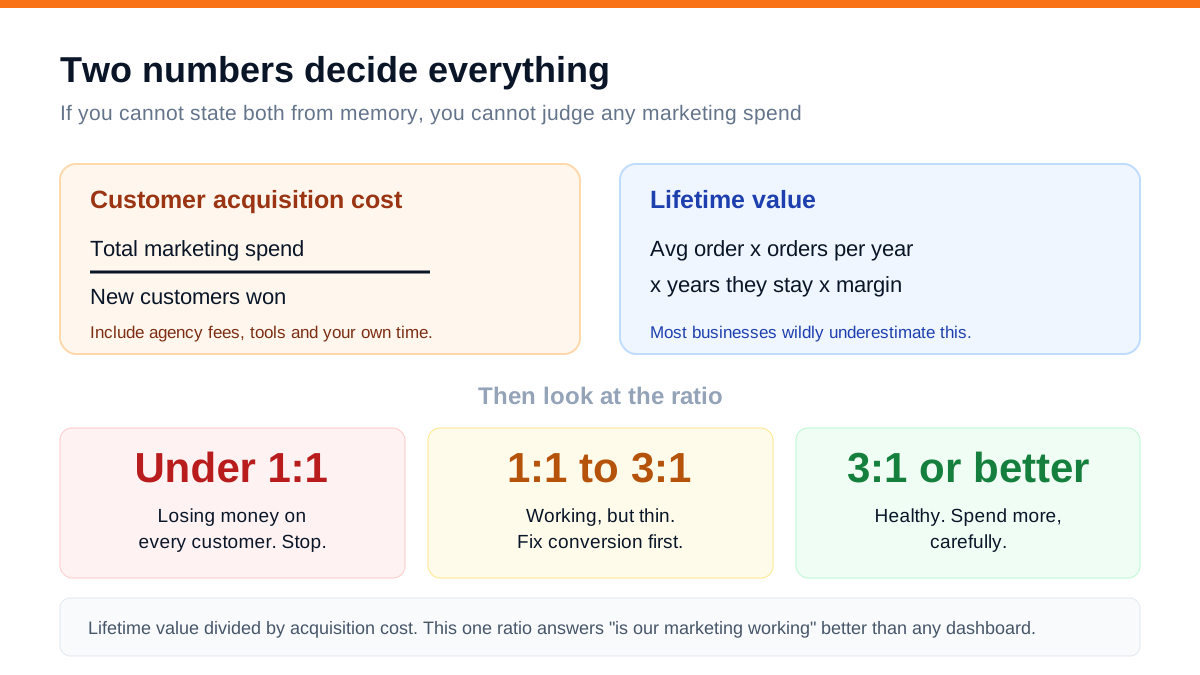
Customer acquisition cost. Total marketing spend in a period, divided by new customers won in that period. Include everything: ad spend, agency fees, software, and a fair value for your own time. Most owners exclude their time and then wonder why the business feels tighter than the numbers suggest.
Lifetime value. Average order value, times orders per year, times the number of years a typical customer stays, times your gross margin. Use margin, not revenue - Rs 1,00,000 of revenue at 12% margin is a very different business from the same revenue at 60%.
Then divide lifetime value by acquisition cost:
- Under 1:1 - you lose money on every customer. This is not a marketing problem to optimise; stop and fix the economics
- 1:1 to 3:1 - it works but there is no room for error. Usually the fix is conversion and retention, not more spend
- 3:1 or better - healthy. This is where increasing spend makes sense
The most common error we see is a business calculating acquisition cost against first-order value only. A gym owner spending Rs 2,000 to acquire a member paying Rs 1,500 a month concludes marketing is unaffordable. If that member stays fourteen months, the real ratio is roughly 10:1 and they should be spending far more.
How to actually calculate your ROI
Do this quarterly, on paper, in about twenty minutes.
- 1Add up everything spent on marketing in the quarter. Ads, agency, tools, freelancers, and your own hours at a realistic rate
- 2Count new customers won in that quarter, and note where each came from. If you cannot attribute them, start asking every enquiry 'how did you find us' - it is imperfect but far better than nothing
- 3Multiply by gross margin, not revenue. Profit generated, not turnover
- 4Add the value of repeat business from customers acquired in previous quarters through marketing. This is the part everyone leaves out
- 5Subtract the spend from the profit, divide by the spend. That is your return
Two rules make this meaningful. Track by channel, not in aggregate - an overall 2x return often hides one channel at 6x and another at 0.3x, and the aggregate tells you to do nothing while the detail tells you exactly what to change. And review quarterly, not monthly, because monthly data on a small business is mostly noise and reacting to it leads to abandoning things right before they work.
Realistic payback timelines by channel
Most disappointment in digital marketing comes from judging a slow channel on a fast channel's timeline.
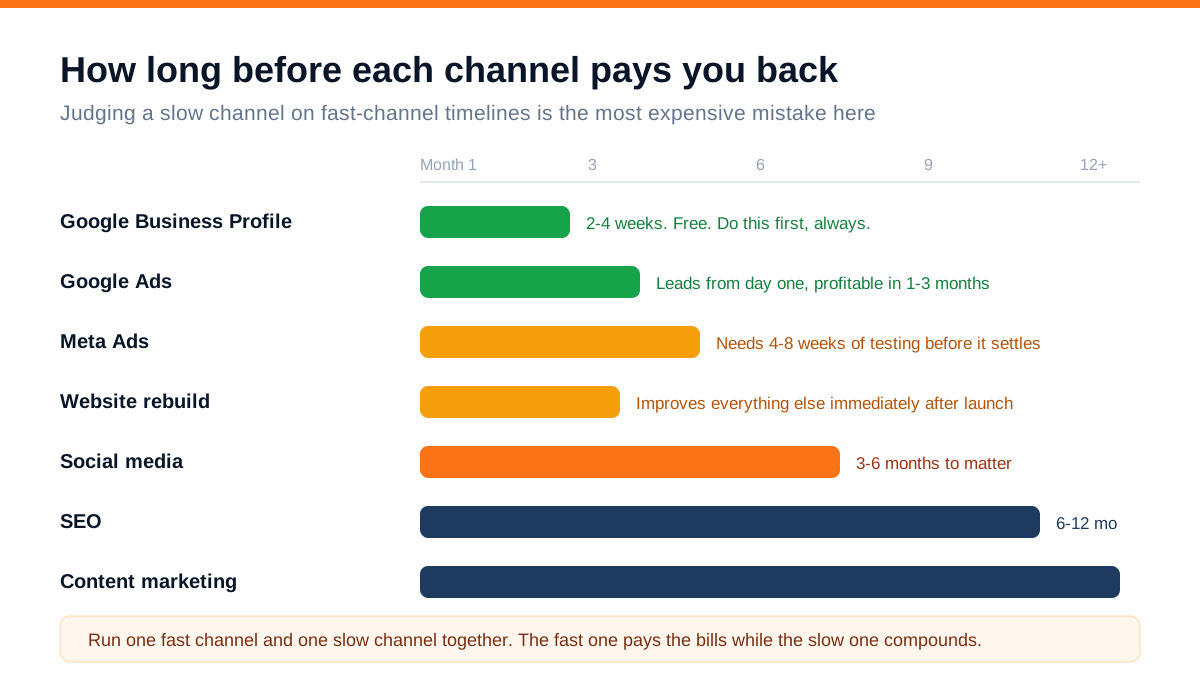
Google Business Profile - two to four weeks, free. For any business with a physical location or a service area, this is the highest-return thing available and it costs nothing. Do it before anything else.
Google Ads - enquiries from day one, typically profitable within one to three months once the wasted spend is cleaned out. Fastest paid channel because it captures people already searching.
Meta Ads - four to eight weeks of testing before performance settles. You are creating demand rather than capturing it, which takes longer to tune.
A website rebuild - improves the return of every other channel immediately after launch, which is why doing it after starting ads is backwards.
Social media - three to six months before it contributes meaningfully.
SEO - six to twelve months, then compounding.
Content marketing - nine to eighteen months, then the cheapest leads in the business.
The practical implication: run one fast channel and one slow channel simultaneously. The fast one pays the bills while the slow one compounds. Businesses that run only slow channels run out of patience; businesses that run only fast channels never build anything they own.
Where the budget actually leaks
When ROI is poor, owners almost always blame the ad platform. In our experience the ad account is the problem maybe a quarter of the time.
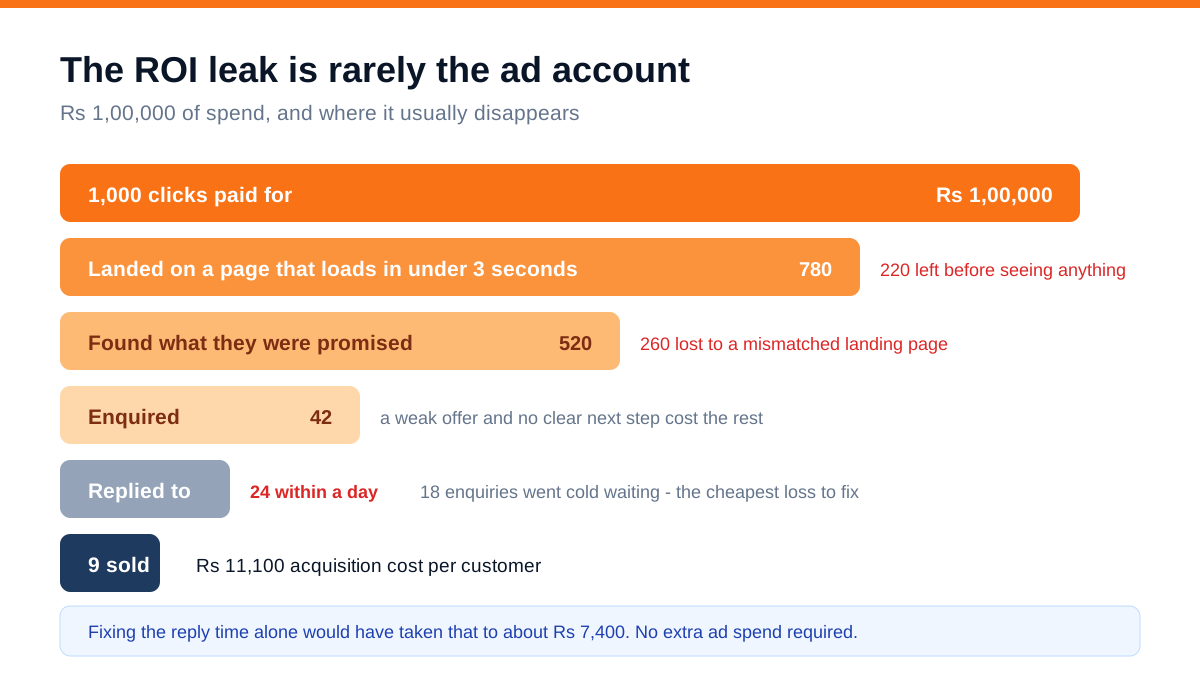
Trace Rs 1,00,000 of spend through a typical small business and you find losses at every stage: visitors leaving before a slow page loads, a landing page that does not match what the ad promised, no clear next step, and - the biggest one - enquiries that sit unanswered for a day.
In that example, fixing response time alone takes acquisition cost from around Rs 11,100 to roughly Rs 7,400 with no additional ad spend. That is a 33% improvement in ROI from a change that costs nothing but attention.
The five leaks, in the order they are usually worth fixing:
- 1Slow follow-up. Enquiries answered within an hour convert several times better than the same enquiries answered next day. Free to fix, biggest single gain
- 2A weak or unclear offer. If your page does not say what it costs, what is included and what happens next, people leave to find someone who does
- 3A slow or confusing website, particularly on a phone
- 4Traffic that was never going to buy - broad targeting, wrong keywords, no negative keywords
- 5No repeat business system. Acquiring a customer once and never contacting them again is where most small business ROI is lost, and it is invisible on any dashboard
What good looks like, by business type
Rough benchmarks from Indian small business work. Treat these as sanity checks, not targets.
- Local services (clinic, salon, repairs, tuition): cost per enquiry Rs 80 to Rs 400; a healthy business converts 20% to 40% of enquiries
- Retail and e-commerce: cost per order should sit below roughly 20% to 25% of gross margin per order; anything above is squeezing you
- B2B and industrial: cost per qualified enquiry Rs 400 to Rs 2,500 is normal, and it is fine because order values are large and customers repeat
- High-ticket services (interiors, construction, consulting): cost per enquiry Rs 800 to Rs 3,000, with a long sales cycle. Judge these on a six-month window, never monthly
If your numbers are far outside these, that is worth investigating - but wide variation is normal across cities and categories, and being outside the range is a prompt to look, not proof of failure.
The returns nobody puts in a spreadsheet
Some genuine returns resist measurement, and ignoring them consistently undervalues marketing.
Brand searches. When people start searching your business name directly, that traffic looks free. It was created by everything else you did.
Shorter sales conversations. A buyer who read three of your articles before calling needs far less convincing. Your close rate improves and nothing in the dashboard shows why.
Better quality enquiries. Content and clear pricing filter out people who were never going to buy. Fewer enquiries, more orders, and the enquiry-count metric goes down while the business improves.
Recruitment and supplier credibility. A business that looks established online hires and negotiates better.
Assisted conversions. Someone finds you through an article, leaves, and returns two months later via a brand search. Simple attribution credits the brand search with everything, which is why content and social so often get cut just before they start paying.
None of this justifies unmeasured spending. But when a channel looks marginal on direct attribution, check whether it is doing work that shows up elsewhere before cutting it.
How much should a small business spend?
The common advice is a percentage of revenue - 5% to 10% for established businesses, more for growth. It is a reasonable starting point and a poor decision rule.
Better: work backwards from a target.
If you want 20 new customers a month, and your acquisition cost is around Rs 1,500, you need roughly Rs 30,000 a month. If you do not know your acquisition cost yet, start at whatever you can afford to spend for three months without stress, measure properly, and then let the ratio decide.
Three practical rules:
- Never spend money you need back this month. Marketing budgets under that pressure get switched off in week three, which guarantees a loss
- Commit for three months minimum on any channel, and nine on SEO or content
- Increase spend only where the ratio is above 3:1. Scaling a 1.5:1 channel just loses money faster
Our pricing guide covers what the individual services actually cost in India if you want reference figures.
Signs your marketing is genuinely not working
Sometimes the honest answer is that it is not working. Signs it is real rather than impatience:
- Six months in with no movement in enquiries, traffic or rankings. Not one bad month - six flat ones
- Enquiries arrive but are consistently the wrong kind. A targeting or messaging problem, and more spend will make it worse
- Cost per enquiry rising steadily over a quarter with no change in what you sell
- Nobody can tell you what changed - if your agency reports impressions and reach and cannot state cost per enquiry, that is a reporting problem masking a performance one
- You are the only one who knows the numbers. If your marketing partner does not know your acquisition cost or margin, they cannot be optimising for profit
What is not a sign: a single bad month, seasonal dips, or SEO showing nothing at month three.
A worked example: a Rs 60,000 a month budget
A flooring and tiles business in a tier-2 city, average order around Rs 85,000, gross margin about 28%, repeat and referral rate roughly 0.4 additional orders per customer.
Their budget of Rs 60,000 a month was split: Rs 30,000 Google Ads, Rs 12,000 Meta Ads, Rs 18,000 SEO and content.
Months 1 to 3. Google Ads produced 96 enquiries at about Rs 940 each, closing 11 orders. Meta produced 54 enquiries at Rs 670, closing 2 - poor, because the enquiries were browsing rather than buying. SEO produced nothing. Total: 13 orders, gross profit around Rs 3.1 lakh against Rs 1.8 lakh spend. A 1.7x return, and the owner was unhappy.
What we changed. Meta was re-pointed from a general awareness campaign to retargeting people who had visited the site, and a WhatsApp reply routine was put in place - previously enquiries after 6pm were answered the next afternoon.
Months 4 to 6. Same total budget. Google Ads: 104 enquiries, 19 orders - the improvement was almost entirely faster replies. Meta retargeting: 31 enquiries, 7 orders at Rs 1,160 each. SEO: 40 organic enquiries starting from month five, 6 orders. Total 32 orders, gross profit about Rs 7.6 lakh against Rs 1.8 lakh spend. A 4.2x return.
Months 7 to 12. SEO became the largest single source and the cheapest. Counting repeat orders, the twelve-month return on Rs 7.2 lakh of spend was roughly 5.8x.
The budget never changed. The ad accounts were barely touched. What changed was who answered the phone and how fast.
Most small businesses do not have a marketing spend problem. They have a follow-up problem that shows up as a marketing spend problem.
Frequently asked questions
What is a good ROI for digital marketing?
For a small business, a lifetime-value to acquisition-cost ratio of 3:1 or better is healthy. On direct first-order return, 2x to 4x is normal for a well-run paid campaign, while SEO and content typically look poor for the first six months and then exceed paid channels substantially. Judge each channel against its own timeline, not against a single blended target.
How long before digital marketing pays for itself?
It depends entirely on the channel. Google Business Profile can pay back in weeks, Google Ads in one to three months, social in three to six, SEO in six to twelve, and content marketing in nine to eighteen. A business that needs return this quarter should not be starting with SEO, and a business that wants durable low-cost leads should not be relying only on ads.
How much should a small business spend on digital marketing?
Work backwards from a customer target rather than using a percentage of revenue. Customers wanted, multiplied by your acquisition cost, gives the budget. If you do not know your acquisition cost, start with an amount you can sustain for three months without pressure, measure properly, then scale only the channels above a 3:1 ratio.
Is digital marketing worth it for a very small business?
Often yes, but the starting point differs. For a business under roughly Rs 20 lakh annual turnover, the highest-return actions are usually free or cheap: a complete Google Business Profile, collecting reviews, a working website, and replying to enquiries quickly. Paid advertising makes sense once those are in place, because spending on ads while enquiries go unanswered simply buys more missed opportunities.
How do I know if my agency is delivering value?
Ask for cost per enquiry and cost per customer, by channel, every month. If the report leads with impressions, reach and follower growth, and nobody can state your acquisition cost, that is a warning sign. A good partner will also know your margin and your lifetime value, because those determine what a sensible cost per customer even is.
Should I do SEO or ads first?
Ads first if you need customers within the quarter, SEO alongside as soon as cash flow allows. Doing only ads means renting every customer indefinitely; doing only SEO means several months with nothing coming in. The combination is what most successful small businesses end up running, with the paid share falling over time as organic builds.
Where to start
Spend twenty minutes this week calculating your acquisition cost and lifetime value for the last quarter. Not estimated - from your actual accounts. Most owners find at least one surprise, and usually it is that customers are worth considerably more than they assumed.
Then look at the leak list and find your slowest step. For the large majority of Indian small businesses, that step is how long an enquiry waits for a reply, and it costs nothing to fix.
If you want an outside read on where your money is going, tell us what you are spending and what you are getting and we will tell you what we would change first - and our packages show what our own work costs before you ask. If you already know you need lead generation or Google Ads specifically, start there.