
Website Redesign: How to Know If You Need One (And How Not to Lose Your Rankings)
The conversation almost always starts the same way: 'our website looks old, we want to redesign it'.
Sometimes that is exactly right. More often, when we look at the site, the design is not the problem. It is slow, or every service is crammed onto one page, or the contact form has been silently failing for eight months. A redesign would fix none of that, and would cost five times what fixing it would.
And there is a worse outcome, which we see several times a year: a business spends Rs 90,000 on a beautiful new site, launches it, and loses two-thirds of its organic traffic overnight because nobody built a redirect map. The new site looks better and produces fewer customers.
This guide is about making that decision properly and running the project without breaking what already works.
What's in this guide
- 1Diagnose before you decide
- 2The signs that genuinely justify a rebuild
- 3Fix, redesign or rebuild: three different projects
- 4Bad reasons to redesign
- 5The redirect map, and why redesigns lose traffic
- 6Keep what is already working
- 7Running the project in three phases
- 8What it costs and how long it takes
- 9How to judge whether it worked
- 10A worked example: a hospitality supplier
- 11Frequently asked questions
Diagnose before you decide
'It looks old' is a symptom, not a diagnosis. Before spending anything, find out what is actually wrong. Four checks, about an hour in total.
Open it on your phone on mobile data and time how long until you can read something. Over four seconds and speed is your primary problem, whatever else you were planning to change.
Look at Google Analytics. Which pages get traffic? Where do people leave? If 80% of visitors land on one page and leave, that page is the problem, not the site.
Look at Search Console. What are you ranking for, and which pages earn it? You need this list before any redesign, because those are the pages you must not break.
Ask five customers to find something on it while you watch and say nothing. Fifteen minutes of this tells you more than any audit report. People get stuck in places you would never predict.
After those four checks you will usually find the real issue is one of: it is slow, it does not explain what you sell, there is no clear next step, or it is genuinely broken on phones. Only the last of those always requires a rebuild.
The signs that genuinely justify a rebuild
There are five situations where starting again is the right call rather than an expensive preference.
1. You do not own or control it. No access to the domain registrar, no hosting login, no admin panel. The developer has disappeared or holds the keys. This is the strongest reason of all, because you cannot fix what you cannot access, and one lapsed renewal can take the business offline.
2. Nothing can be edited without paying someone. If changing a price or adding a photograph means an invoice and a three-day wait, the site will freeze and age. Sites that cannot be maintained stop being assets within about a year.
3. It is genuinely broken on phones. Not dated - broken. Pinch-to-zoom required, buttons that do not work, content missing on mobile. Since Google judges the mobile version, this is a ranking problem as well as a customer problem, as covered in our mobile-first guide.
4. One page for every service. A single 'Services' page listing eight offerings cannot rank for eight different searches. Fixing this properly usually means restructuring the site, which is close to a rebuild anyway.
5. The business has changed. New services, new customer type, a different market. If the site describes a business you no longer run, no amount of restyling fixes it.
Notice what is not on this list: 'competitors look more modern', 'we are bored of it', and 'we want to add animations'.
Fix, redesign or rebuild: three different projects
These get talked about as one thing. They are not, and confusing them is how businesses overspend.
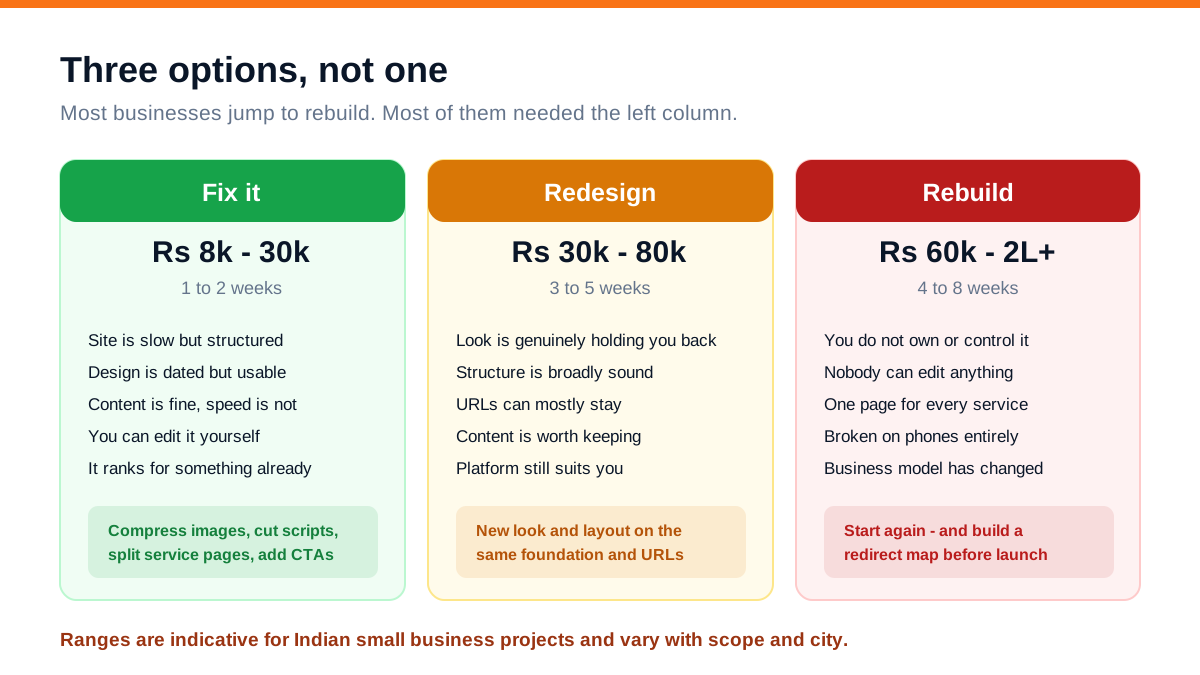
Fix it - roughly Rs 8,000 to Rs 30,000, one to two weeks. The right answer when the structure is sound but performance is not. Compress images, remove unused scripts, split the services page, add clear calls to action, repair the form. In our experience this is the correct answer for slightly over half the businesses that ask us for a redesign, and it is worth saying so even though it is the smaller job.
Redesign - roughly Rs 30,000 to Rs 80,000, three to five weeks. New look and layout on the same foundation, keeping the URLs and the content that works. Right when the appearance genuinely holds you back but the structure and platform are fine.
Rebuild - roughly Rs 60,000 to Rs 2,00,000 and up, four to eight weeks. Start again. Right when one of the five signs above applies. Requires a redirect map, and requires it before launch rather than after.
The ranges are indicative for Indian small business projects and move with scope and city. What matters more than the exact figure is matching the project to the actual problem.
Bad reasons to redesign
Every one of these has cost a client money at some point.
- 'A competitor's site looks nicer.' Their site may convert worse than yours. You are comparing appearance against appearance while ignoring which one produces enquiries
- 'We are bored of it.' You see your site far more than any customer does. Familiarity is not a business problem
- 'A new marketing person wants to.' Sometimes valid, often a way of making a mark. Ask what specific measured problem it solves
- 'We want animations and video backgrounds.' These usually slow the site and rarely improve conversion. On mobile they often actively harm it
- 'Someone said we need a modern framework.' Technology choice matters far less than speed, structure and content. Rebuilding for a technology reason alone is a cost with no customer-facing benefit
- 'Traffic is down, so we need a new site.' Find out why traffic is down first. It is frequently a search algorithm change, a lost link, or a technical fault - and a redesign can make it considerably worse
The redirect map, and why redesigns lose traffic
This is the single most expensive mistake in the entire subject, and it is entirely avoidable.
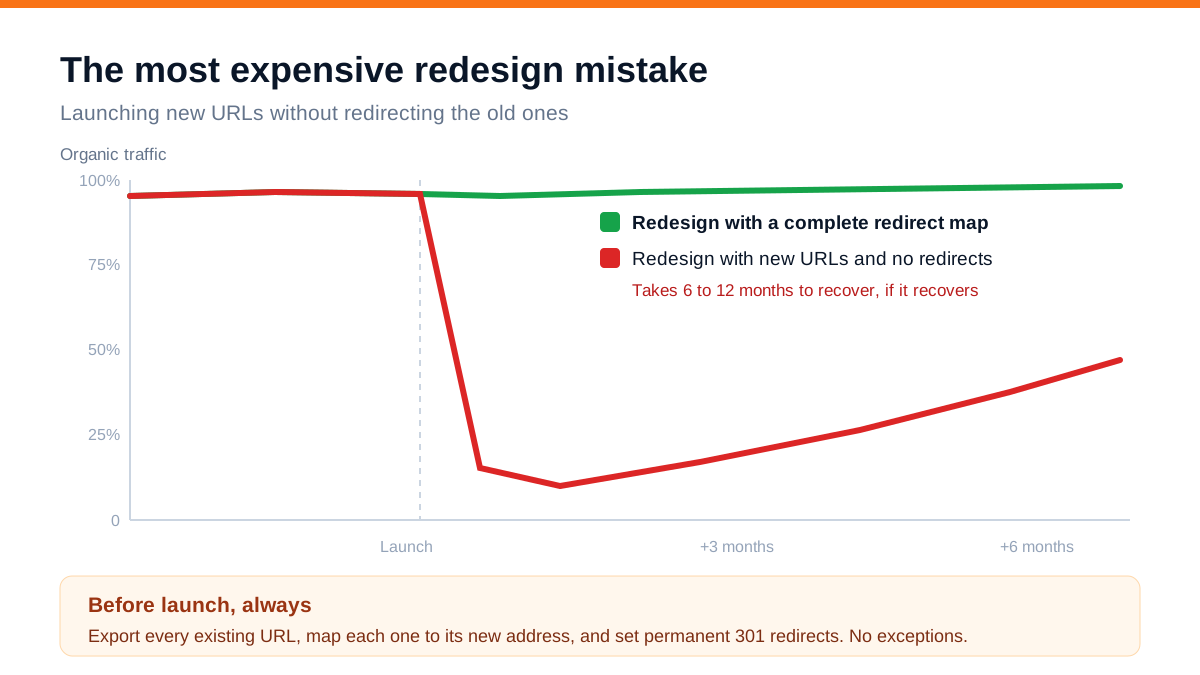
Every page that ranks has value accumulated over years. That value is attached to the URL. Change the URL without telling search engines where it went, and the value evaporates. Every link pointing at the old address now leads to a 404.
The damage is severe: traffic often falls 50% to 80% within two weeks of launch, and recovery takes six to twelve months if it happens at all. Businesses frequently blame the new design and rebuild again, which compounds the problem.
The prevention takes an afternoon:
- 1Before building, export every existing URL. Search Console, your sitemap, and a crawl of the site
- 2Map each old URL to its new address. In a spreadsheet, one row per page. Every single page, not just the important ones
- 3Set permanent 301 redirects for every changed URL, implemented before launch
- 4Test them after launch. Actually visit fifty old URLs and confirm each lands somewhere sensible
- 5Submit the new sitemap and watch Search Console's coverage report daily for the first month
The simplest safeguard: keep the URLs that already rank. There is rarely a good reason to change a URL during a redesign. If a page works, leave its address alone.
Keep what is already working
The instinct in a redesign is to replace everything. That instinct is expensive.
Before the project starts, list your top twenty pages by traffic and your top twenty by enquiries. Those pages have earned their position. Carry them across with their URLs, their headings and their content largely intact. Improve the layout around them if you must; do not rewrite them because they look dated.
The same applies to content people actually read. We have watched businesses delete a 1,500-word guide that was bringing 400 visits a month because it 'did not fit the new design'. That guide was worth more than the redesign.
Also carry over: your analytics and Search Console setup, your schema markup, your image alt text, your internal links, and any pages that earned links from other websites. All of these are quietly load-bearing and all of them get discarded routinely.
The mindset that helps: a redesign is a renovation, not a demolition. Preserve the parts of the building that are holding the roof up.
Running the project in three phases
Redesigns go wrong in the planning, not in the design.
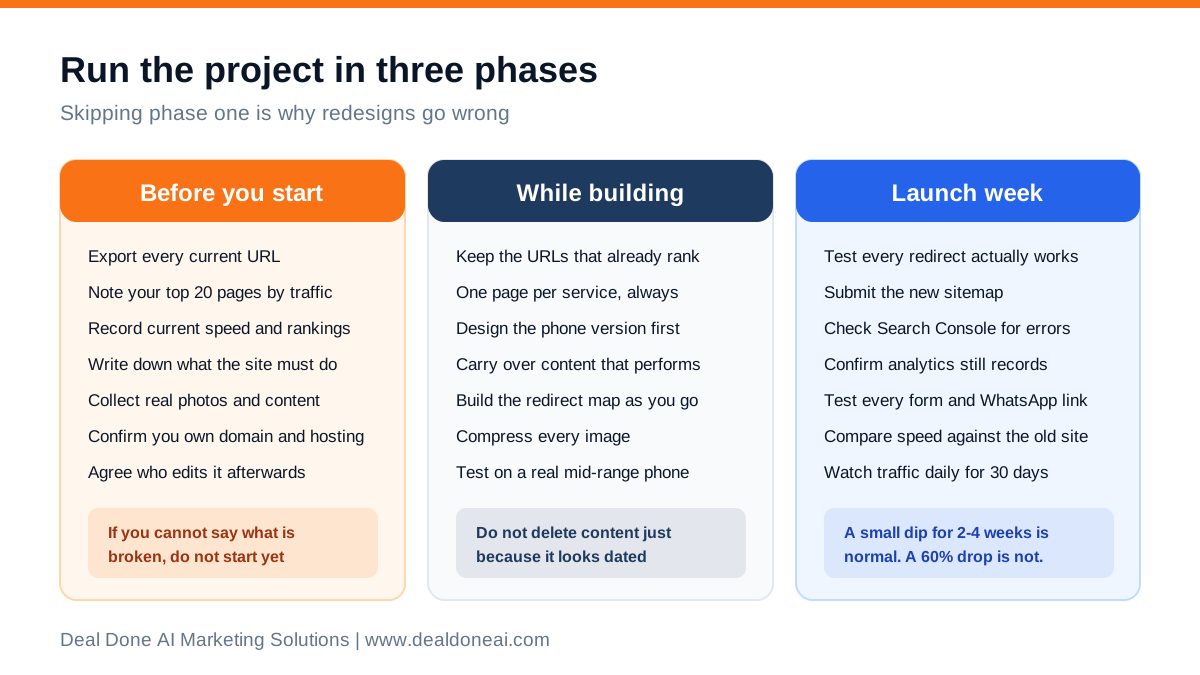
Before you start is the phase everyone skips. Export every URL, note your top twenty pages, record current speed and rankings so you can prove whether the project helped, write down what the site must actually do, collect real photographs and content, confirm you own the domain and hosting, and agree who edits the site afterwards. If you cannot state what is broken in one sentence, you are not ready to start.
While building, keep the URLs that rank, insist on one page per service, design the phone version first, carry over content that performs, build the redirect map as you go rather than at the end, compress every image, and test on a real mid-range phone rather than a desktop browser.
Launch week is where the risk concentrates. Test every redirect, submit the new sitemap, watch Search Console for errors, confirm analytics is still recording, test every form and WhatsApp link personally, compare speed against the old site, and watch traffic daily for thirty days. A small dip for two to four weeks is normal as search engines re-crawl. A 60% drop is not normal and needs investigating the same day.
What it costs and how long it takes
Beyond the figures above, three things determine the real cost.
Content is the usual delay. Development rarely holds a project up; waiting for text, photographs and approvals does. Gathering your content before the project starts typically halves the timeline. Assume you will need to write or approve everything, because the developer cannot invent your prices and processes.
Scope creep is the usual overrun. 'Can we also add a blog, a booking system and a login area?' Each addition extends the timeline and the invoice. Agree the page list in writing and treat additions as separate projects.
Ongoing cost is real. Budget Rs 8,000 to Rs 30,000 a year for domain, hosting, backups, updates and small content changes. A site nobody maintains starts degrading within eighteen months, which is how businesses end up redesigning every two years.
One framing that helps decide: compare the cost against what a customer is worth to you. If a customer is worth Rs 30,000 in margin, a Rs 70,000 project needs three extra customers to pay for itself. Whether that is likely is a better test than whether the quote feels expensive. Our guide to digital marketing ROI covers that arithmetic properly.
How to judge whether it worked
Record these before launch, or you will never know whether the money did anything:
- 1Organic traffic, monthly, for the six months prior
- 2Enquiries per month, and where they came from
- 3Mobile load time on a real phone, timed
- 4Your top twenty ranking keywords and their positions
- 5Conversion rate - enquiries divided by visitors
Then check at thirty, ninety and one hundred and eighty days. Expect a small dip in the first month, recovery by month two, and improvement by month three. If traffic is still below the old level at month three, something is technically wrong - almost always redirects - and it needs fixing rather than waiting.
The metric that matters most is enquiries per hundred visitors. A redesign that halves your traffic but doubles your conversion rate has still failed if it produces fewer enquiries. Judge the outcome, not the appearance.
A worked example: a hospitality supplier
A supplier of hotel and restaurant equipment came to us wanting a full rebuild. Their site was six years old and, in their words, embarrassing.
The diagnosis said otherwise. Structure was reasonable - seven separate product category pages, each ranking for something. The real problems were a 9.2 second mobile load time caused by uncompressed images and a five-slide carousel, a contact form that had been failing silently for an unknown period, and no pricing information anywhere.
We proposed fixes instead of a rebuild: images compressed, carousel removed, three unused plugins deleted, the form repaired and rerouted to a monitored inbox, indicative price ranges added to each category page, and a sticky WhatsApp button. Total cost Rs 24,000, delivered in nine days.
Mobile load time went to 2.3 seconds. Over the next three months, organic traffic rose about 40% with no new content, and enquiries went from roughly 18 a month to 64 - a large share of which came simply from the form working again.
Eight months later they did commission a redesign, on a much clearer brief and with every ranking URL preserved. It was the right sequence: fix what is broken, find out what the site can do, then decide whether it needs to look different.
A redesign is a renovation, not a demolition. Before you knock anything down, find out which walls are holding up the roof.
Frequently asked questions
How do I know if I need a website redesign or just fixes?
Check four things: mobile load time, whether you can edit the site yourself, whether each service has its own page, and whether the site works properly on a phone. If the structure is sound and only speed and clarity are poor, fixes will do - typically Rs 8,000 to Rs 30,000 and under two weeks. Rebuild only if you do not own or control the site, nothing can be edited, it is genuinely broken on mobile, or the business itself has changed.
Will a redesign hurt my Google rankings?
It can, badly, if URLs change without permanent 301 redirects - drops of 50% to 80% are common and recovery takes six to twelve months. Done properly, with every old URL mapped and redirected and the well-performing content carried across, a redesign should cause only a small dip for two to four weeks before recovering and improving.
How much does a website redesign cost in India?
Roughly Rs 30,000 to Rs 80,000 for a redesign on an existing structure, and Rs 60,000 to Rs 2,00,000 or more for a full rebuild, depending on page count, functionality and city. Targeted fixes to an existing site usually fall between Rs 8,000 and Rs 30,000. Budget an additional Rs 8,000 to Rs 30,000 a year for hosting and maintenance whichever route you take.
How long does a website redesign take?
Three to five weeks for a redesign, four to eight for a full rebuild. The delay is almost never development - it is waiting for content, photographs and approvals from the business. Having your text, images and pricing ready before the project starts is the single biggest thing you can do to shorten it.
How often should a business redesign its website?
Every three to five years is typical, with small content updates monthly and a technical review annually. Redesigning more often than every three years is usually a sign that the previous project addressed appearance rather than the underlying problems. A well-built site that is maintained ages far more slowly than one that is left alone.
What should I do before starting a redesign?
Export every existing URL, note your top twenty pages by traffic and by enquiries, record current mobile speed and keyword positions, confirm you own the domain and hosting accounts, and write down in one sentence what problem the project is solving. If you cannot write that sentence, the project is not ready to start.
Where to start
Do the four diagnostic checks this week - phone test, Analytics, Search Console, and five customers trying to find something. They cost nothing and they will tell you which of the three projects you actually need.
If it turns out you need fixes rather than a rebuild, that is good news: it is cheaper, faster, and it will not put your existing rankings at risk.
Our website development team handles all three - targeted fixes, redesigns and full rebuilds with proper redirect mapping - and the packages page shows what each includes. If you want an honest read on which one you need, send us your website link. We will tell you if fixes are enough, even though it is the smaller job.