
Local SEO in India: The Google Business Profile Playbook That Fills Your Phone
There is a particular kind of frustration that comes from watching a competitor with a worse product, a worse shop and worse prices appear above you on Google Maps. You know you are better. Google apparently does not.
The good news is that local search is one of the few places where a small business can genuinely outrank a bigger one, quickly, without spending money on ads. Most of your competitors have a half-finished Google Business Profile, four reviews from 2023 and no idea what a service area is. The bar is low, and it is entirely fixable.
This is the process we run for local clients - clinics, showrooms, contractors, coaching centres - in the order we run it, with the reasoning behind each step.
Table of contents
- Why local search matters more than you think
- How Google decides the map pack
- Setting up your profile correctly
- The optimisation checklist
- Getting reviews without begging
- Local signals on your website
- Citations and directories
- Measuring what matters
- Frequently asked questions
Why local search decides more than you think
Roughly half of all Google searches carry local intent, and a large share of those are made on a phone by someone who intends to act soon. 'Near me' searches are not research - they are shopping.
What makes local different from ordinary SEO is the geometry of the result. Below the ads sit three business listings with a map - the local pack. Those three take the overwhelming majority of clicks and calls. Position four is not a slightly worse position four; it is another page entirely, hidden behind a 'more places' link that most people never tap.
So local SEO is not really about ranking. It is about getting into a three-slot box. That sounds harder than it is, because the competition for those slots is usually not trying.
In most Indian tier-two and tier-three cities, fewer than one in five businesses in a category has a fully completed Google Business Profile. Completing yours is often enough to move you several places.
How Google actually picks the top three
Google is public about the three things that decide local ranking: relevance, distance and prominence. In practice they break down like this:
Relevance is how well your profile matches what was searched. This is mostly under your control - categories, services, description, and the words on your website.
Distance is how close you are to the searcher. You cannot change this, and you should stop trying. What you can change is which searches you appear for by defining your service area properly.
Prominence is how well known and well regarded you are - reviews, mentions across the web, and links to your site. This is where most of the long-term work sits.
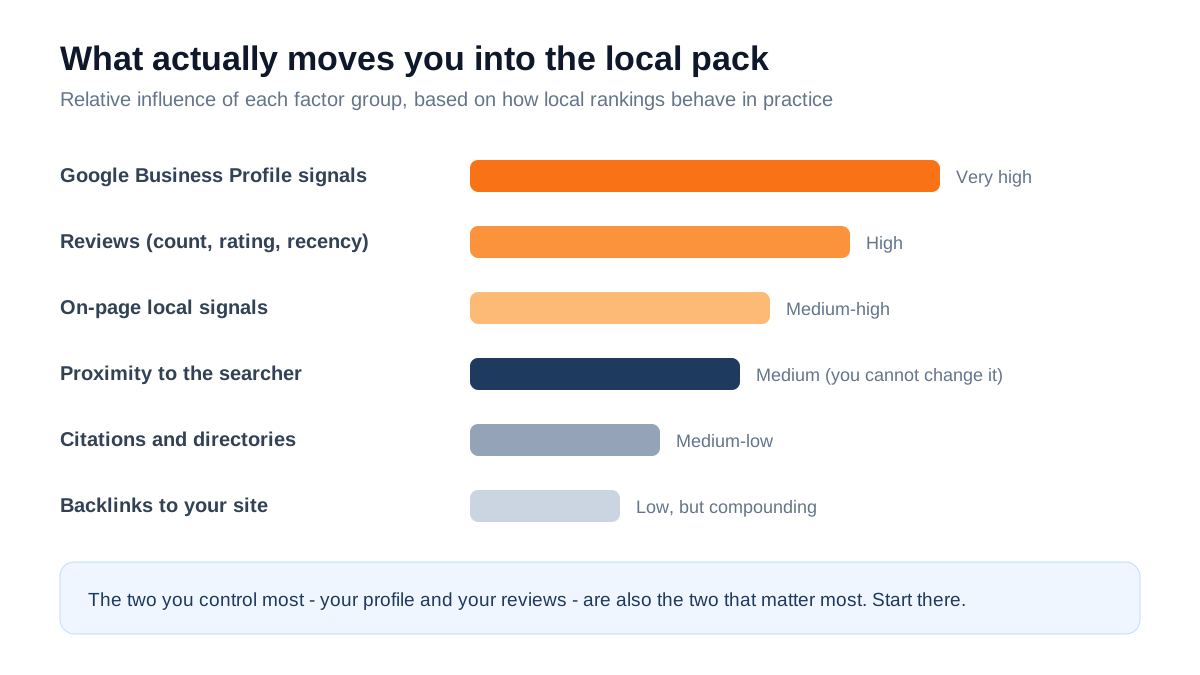
The useful insight in that chart is the mismatch between effort and reward. Businesses spend months chasing backlinks, which move local rankings least, while leaving their category field wrong - which moves them most, and takes ninety seconds to fix.
Step one: build the profile properly
If you already have a profile, do not skip this. Roughly half the profiles we audit have a foundational error that quietly caps their ranking.
- 1Claim and verify. Search your business name on Google. If a listing exists that you do not control, claim it rather than creating a duplicate. Duplicates split your reviews and confuse Google - and they are painful to merge later.
- 2Use your real business name. Not 'Sharma Dental - Best Dentist in Kanpur'. Keyword stuffing the name violates Google's guidelines and is one of the easiest things for a competitor to report. Suspended profiles take weeks to restore.
- 3Choose the primary category with care. This is the single highest-leverage field on the entire profile. 'Dentist' and 'Dental clinic' are different categories with different competitive sets. Check what the top three in your area use - Google shows the category on each listing - and match the one that fits you honestly.
- 4Add secondary categories. A clinic offering orthodontics and implants should list both. Each one opens a new set of searches, so long as it is genuinely a service you provide.
- 5Set the address or service area correctly. If customers visit you, use the address and make sure the map pin is on your actual door - drag it if it is wrong, which it often is. If you travel to customers, hide the address and set a service area instead. Getting this backwards is one of the most common causes of invisibility.
Step two: fill every field that competitors leave empty
Google rewards complete profiles, and completeness is where most local businesses lose without ever realising a contest was happening.
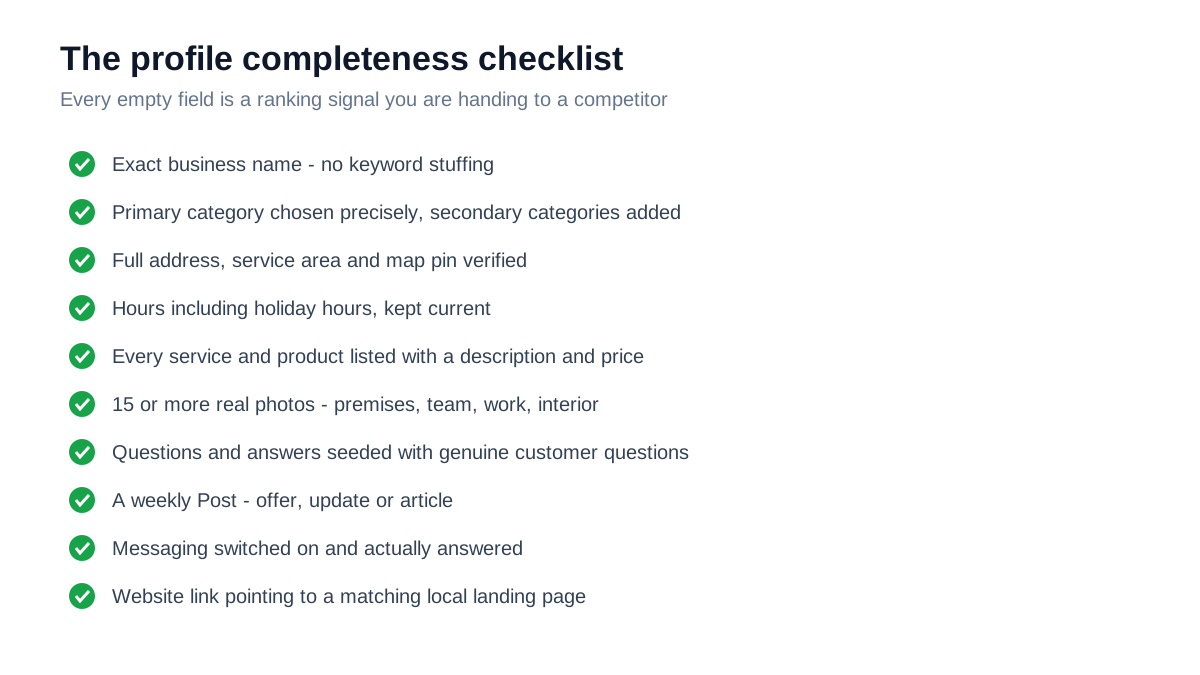
A few of these deserve explanation.
Services and products. List every service separately with its own description, and add prices where you can. This is not just cosmetic - it feeds relevance for specific searches. A salon that lists 'bridal makeup', 'hair smoothening' and 'keratin treatment' individually will appear for all three; one that says 'beauty services' appears for none of them.
Photos, and how many. Profiles with fifteen or more photos consistently get more calls and direction requests than those with three. Post real ones - your premises, your team, work in progress, the interior, the storefront from the road so people can find it. Stock photos are obvious and do nothing. Add a few every month rather than dumping fifty once.
Posts. Google Posts sit on your profile and expire after a week. Publish one weekly - an offer, an update, a new blog article. It signals an active business and takes ten minutes.
Questions and answers. Anyone can post a question on your profile, including competitors. Seed it yourself with the five questions customers genuinely ask - parking, timings, payment methods, whether appointments are needed - and answer them properly. Unanswered questions on a profile look like a closed business.
Messaging. Only switch it on if someone will actually reply. Google measures response rate, and an ignored inbox is worse than no inbox.
Step three: build a review engine, not a review drive
Reviews are the second strongest local ranking factor and the strongest conversion factor. Given two listings, people pick the one with 4.6 stars from 90 reviews over 5.0 from 3 reviews almost every time - volume and recency read as proof.
The mistake most businesses make is treating reviews as a campaign. They ask everyone once, collect eleven reviews in a fortnight, and then stop. Six months later those reviews look stale and the flow has dried up.
What works is a system attached to a moment that already happens:
- Pick the moment. Right after a treatment finishes, a delivery is made, a project is handed over. Satisfaction is highest immediately after the service, not three days later.
- Make it one tap. Get the short review link from your profile, turn it into a QR code, print it on the bill, the counter, the delivery box. Every extra step loses half the people.
- Ask in person, follow up on WhatsApp. A verbal request followed by a message with the link converts far better than a message alone.
- Reply to every review. Every single one. Thank the good ones by name. Answer the bad ones calmly, factually, and without arguing - future customers are reading your reply far more carefully than the complaint.
- Aim for steady flow. Five new reviews a month, every month, beats forty in one week and nothing after. Google reads recency.
Two things to avoid entirely: never buy reviews, and never offer discounts in exchange for them. Both violate Google's policies, both are detectable, and review removal or profile suspension is a far bigger setback than slow honest growth.
A bad review answered well converts better than no bad reviews at all. A perfect 5.0 with eight reviews reads as suspicious; a 4.5 with two hundred reads as real.
Step four: make your website say where you are
Your Business Profile does not work alone. Google cross-checks it against your website, and mismatches cost you.
- Put your full address, city and pincode in the footer of every page, matching the profile exactly.
- Add LocalBusiness schema so search engines can read your address, hours and coordinates without guessing.
- Create a page per location if you have several branches - each with its own address, hours, staff and photos. One page listing five cities ranks in none of them.
- Create a page per service, and mention the city naturally in the heading and opening paragraph. 'Root canal treatment in Kanpur' should exist as a page if you want to rank for it.
- Embed your Google Map on the contact page. It is a small signal, and it genuinely helps customers find you.
This is the part where local SEO connects with ordinary SEO, and where most of the durable gains come from. Our SEO service and Google Business Profile setup are designed to work as one piece for exactly this reason.
Step five: be consistent everywhere else
Citations are mentions of your name, address and phone number on other websites - JustDial, Sulekha, IndiaMART, Practo, industry directories, your local chamber of commerce.
Their ranking value is modest and often overstated by people selling citation packages. What matters is consistency. If four directories list an old phone number and two use a previous address, Google gets conflicting signals about which details are correct, and confidence drops.
Do this once, properly: list your details in a document, exactly as they appear on your Business Profile, then update every directory you can find to match. Ten accurate listings beat two hundred sloppy ones.
Measuring what actually matters
Your Business Profile has a performance section, and most owners never open it. It answers the only questions that matter.
- Searches - how people found you, split by direct (they searched your name) and discovery (they searched a category). Growing discovery searches is the whole point of local SEO.
- Calls, direction requests and website clicks - actual actions, not impressions. These are your real conversion numbers.
- Search terms - the exact phrases that surfaced your profile. This is free keyword research, and it usually reveals two or three services you should be listing separately.
Track the same three numbers monthly. Direction requests are especially telling for a physical business - someone asking for directions is a customer walking towards your door.
When rankings drop: the usual suspects
Local rankings move around more than website rankings, and a wobble of a place or two is normal. A sustained drop usually has one of these causes, roughly in order of how often we find it.
Someone edited your profile. Google allows the public to suggest edits, and competitors do use this. Hours change, categories get swapped, the pin moves. Check your profile monthly and turn on notifications so you hear about changes.
A duplicate listing appeared. Duplicates split your signals and confuse Google about which listing is authoritative. Search your business name and address variations; if you find a second listing, report it as a duplicate rather than deleting anything yourself.
Review velocity stopped. If you collected thirty reviews in one burst and nothing for four months, recency works against you. A steady trickle beats a spike every time.
A competitor got serious. Sometimes nothing on your side changed - somebody else finally completed their profile and started collecting reviews. Look at whoever replaced you and compare their review count, category and photo volume against yours. The gap is usually obvious.
Your NAP went inconsistent. You changed your phone number on the website but not in fifteen directories, or moved premises and updated only the profile. Google reads the contradiction as uncertainty.
A guideline violation. Keyword-stuffed business name, a virtual office address, or a service-area business showing a fake storefront. These can trigger a soft suppression that is invisible - the profile still exists, it simply stops ranking. Fix the violation and request reinstatement.
If you have more than one location
Multi-branch businesses get local SEO wrong in a specific and expensive way: they create one website page listing every city, and one Business Profile for the head office.
The structure that works is straightforward but takes discipline:
- 1One Business Profile per physical location, each verified separately, each with its own phone number where possible. A shared number across ten branches weakens every one of them.
- 2One website page per location, with that branch's address, hours, team photos, parking notes and a map. Not a template with the city name swapped - genuinely different content, because near-identical pages compete with each other and Google picks one.
- 3Location-specific reviews. Ask customers to review the branch they visited. Reviews attach to individual profiles, so a great head-office rating does nothing for your Lucknow branch.
- 4A location index page linking to all branch pages, so both visitors and crawlers can move between them easily.
If you are a single business serving multiple cities without offices in them - a contractor covering four districts, say - do not create fake listings. Use one profile with a service area, and build separate service-area pages on your website instead. Fake locations get suspended, and reinstatement is slow.
Your first 30 days, in order
If you do nothing else from this article, do these in this sequence. Each one takes under an hour.
- 1Day 1 - Claim and verify the profile. Fix the business name to your real, legal name.
- 2Day 2 - Set the primary category after checking what the current top three use. Add relevant secondary categories.
- 3Day 3 - Correct the address and drag the map pin to your actual entrance, or switch to a service area if you travel to customers.
- 4Day 4 - Add every service and product as a separate item with a description, and prices where you are comfortable.
- 5Day 5 - Upload fifteen real photos: exterior from the road, interior, team, work in progress, and your logo.
- 6Week 2 - Write the five questions customers actually ask into the Q&A section and answer them properly. Publish your first Google Post.
- 7Week 2 - Fix the website: address and phone in the footer of every page, LocalBusiness schema added, an embedded map on the contact page.
- 8Week 3 - Build the review system. Get the short link, make a QR code, print it, and brief whoever meets customers on when to ask.
- 9Week 3 - Update your details on the ten most relevant directories so everything matches exactly.
- 10Week 4 - Open the performance section, note your current calls, direction requests and discovery searches, and diarise a monthly check.
That is the entire foundation. Everything after month one is repetition - a post a week, reviews as they come, photos each month, and a glance at the numbers.
Frequently asked questions
How long does local SEO take to work in India?
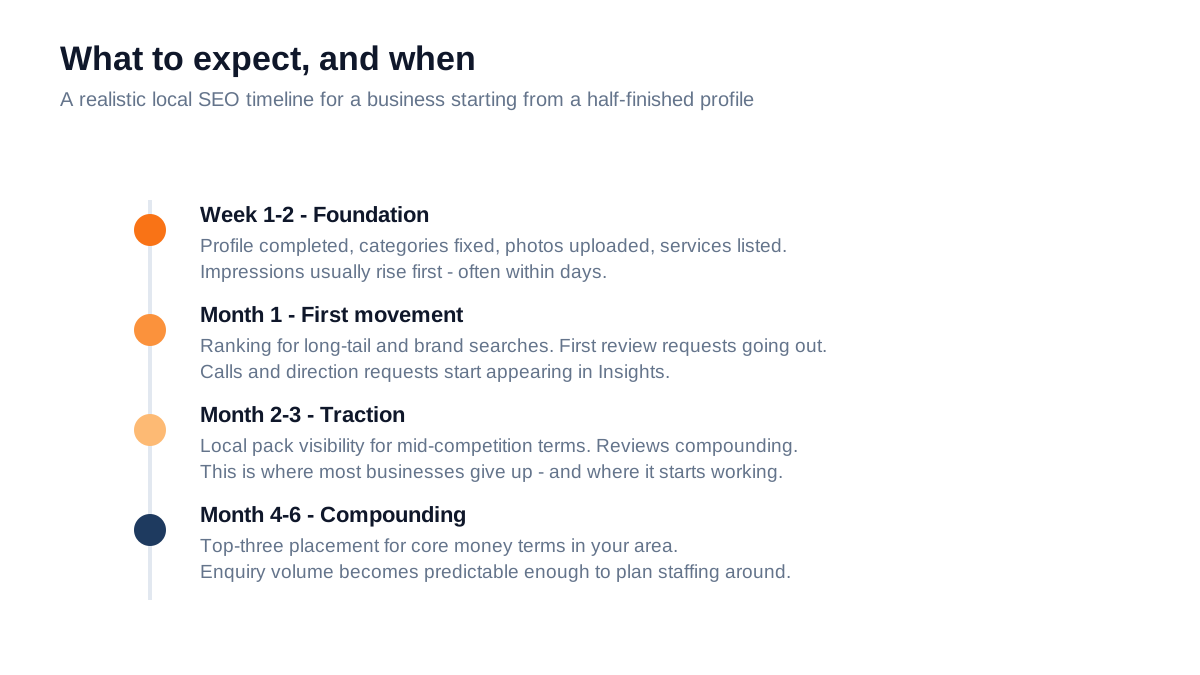
Impressions usually rise within days of completing a profile. Meaningful local pack movement for competitive terms takes two to four months, and a stable top-three position for your main money terms typically lands between month four and month six. It moves faster than website SEO because there is less competition doing it properly.
Can I rank without a physical address?
Yes. Service-area businesses - plumbers, electricians, mobile technicians, home tutors - hide the address and define the areas they cover. You can still appear in the local pack, though usually with slightly less prominence than a business with a verified storefront.
How many reviews do I need to rank in the top three?
There is no fixed number, only a relative one: look at the current top three in your area and aim to exceed their count while maintaining a rating above 4.3. In many tier-two Indian cities that means thirty to sixty reviews. In metros for competitive categories it can mean several hundred.
What if I get a fake or unfair negative review?
Flag it through your profile if it violates Google's policies - spam, off-topic, a competitor, or a person who was never a customer. Removal is not guaranteed. Meanwhile, reply publicly, politely and factually, and keep collecting genuine reviews. Volume dilutes a single bad review far more reliably than a dispute does.
Does posting weekly on Google Posts actually help rankings?
The direct ranking effect is small. The indirect effect is not - posts occupy space on your listing, show recency, and give people a reason to click. Treat it as a ten-minute weekly conversion task rather than a ranking tactic.
Should I pay for citation-building packages?
Usually not. The high-value directories in India are a manageable list you can do yourself in an afternoon. Bulk packages create hundreds of low-quality listings, frequently with inconsistent details, which is the opposite of what you want.
The bottom line
Local SEO rewards thoroughness more than cleverness. There is no trick that puts you in the map pack - there is a profile that is completely filled in, a steady flow of genuine reviews, a website that clearly states where you operate, and consistent details across the web.
Most of your competitors will not do those four things properly. That is the opportunity, and it is why local search remains the highest-return marketing work available to an Indian small business - the work costs time rather than money, and the results keep arriving long after you stop.
Start with your categories and your photos today. Then build the review habit. Everything else compounds from there.
Want your profile handled properly?
We set up and optimise Google Business Profiles as a one-time project - categories, services, photos, posts, Q&A and the local pages on your website that support them. You can see what that includes and what it costs on our Google Business Profile page.
If you would rather we look at your current listing first and tell you what is holding it back, send us the link and we will give you a straight assessment.