
How to Set a Digital Marketing Budget for Your Business in India
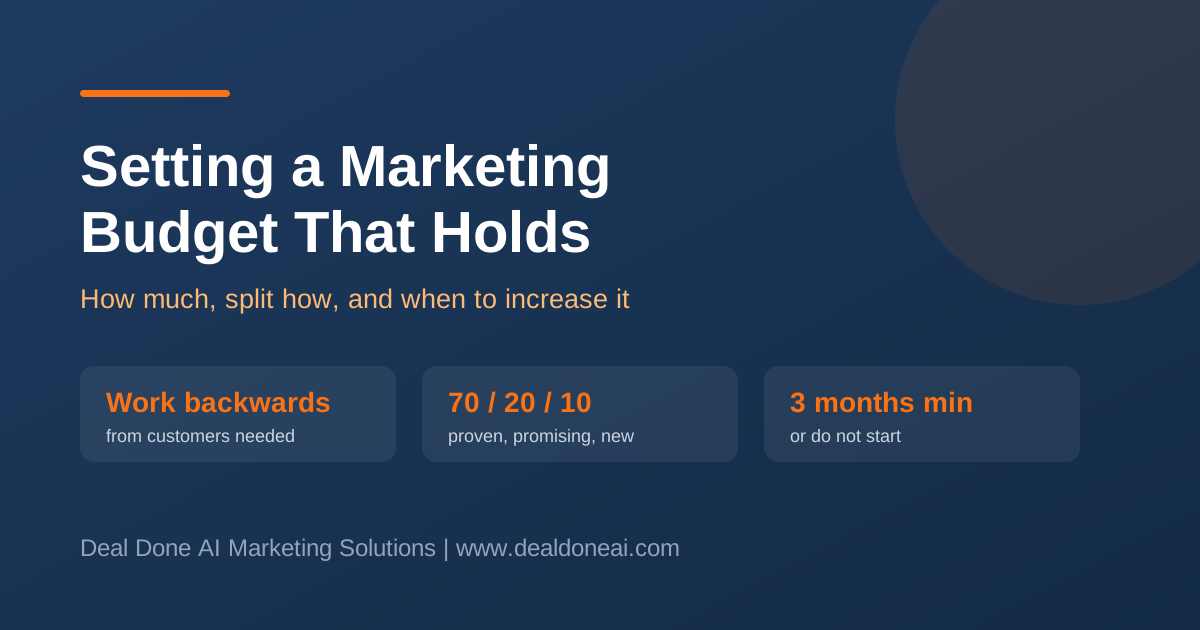
'How much should we spend on digital marketing?' is usually answered with a percentage of revenue. Five to ten percent, more if you are growing. It sounds authoritative and it is almost useless, because it tells you nothing about whether the money will work.
A better question is: what do we need this spend to produce, and can this business currently convert what it produces?
This guide is about the method rather than the price list. If you want the actual market rates for individual services in India, our pricing guide covers those figures in detail. This one is about deciding how much of your own money to commit, where to put it, and when to change it.
What's in this guide
- 1Why percentage-of-revenue budgeting fails
- 2Work backwards from customers, not revenue
- 3Spend priorities by business stage
- 4The 70-20-10 split
- 5Budget for the timeline, not the month
- 6The costs people forget to budget
- 7When to increase, hold or cut
- 8In-house, freelancer or agency
- 9Budgeting mistakes that waste money
- 10A worked example: building a budget from scratch
- 11Frequently asked questions
Why percentage-of-revenue budgeting fails
The percentage rule has one virtue - it stops you overspending relative to size. Beyond that it causes three problems.
It ignores your margins. A business turning over Rs 2 crore at 8% margin and one turning over Rs 2 crore at 55% margin cannot afford the same marketing spend. Revenue is the wrong denominator; gross profit is closer to right.
It ignores what a customer is worth. If one customer is worth Rs 4,000 in margin, and another business's customer is worth Rs 4,00,000, they should not be budgeting by the same rule. The second business can profitably spend a hundred times more per enquiry.
It hides whether the money is working. A percentage tells you what to spend. It never tells you whether to keep spending it. Businesses on percentage budgets tend to renew the same spend every year without ever asking what it produced.
The alternative takes twenty minutes and gives you a number you can defend.
Work backwards from customers, not revenue
Start from the outcome you actually want.
- 1How many new customers do you want per month? A real number - 15, 40, 200
- 2What is your enquiry-to-customer rate? If one in four enquiries becomes a customer, 15 customers needs 60 enquiries
- 3What does an enquiry cost you today? From your own data if you have it, or a cautious estimate if not. Say Rs 500
- 4Multiply. 60 enquiries at Rs 500 is Rs 30,000 a month
- 5Sanity-check against customer value. If a customer is worth Rs 12,000 in gross margin, 15 customers is Rs 1,80,000 of margin against Rs 30,000 of spend. That works. If a customer is worth Rs 1,500, it does not, and no agency can fix that arithmetic
If you do not know your enquiry cost or conversion rate yet, that is the actual first task. Spend a modest amount for three months purely to find out - treat it as buying information rather than buying customers. The numbers you get will make every subsequent budget decision straightforward, and they are covered in more depth in our guide to digital marketing ROI.
Spend priorities by business stage
The same rupee does different work depending on where the business is.
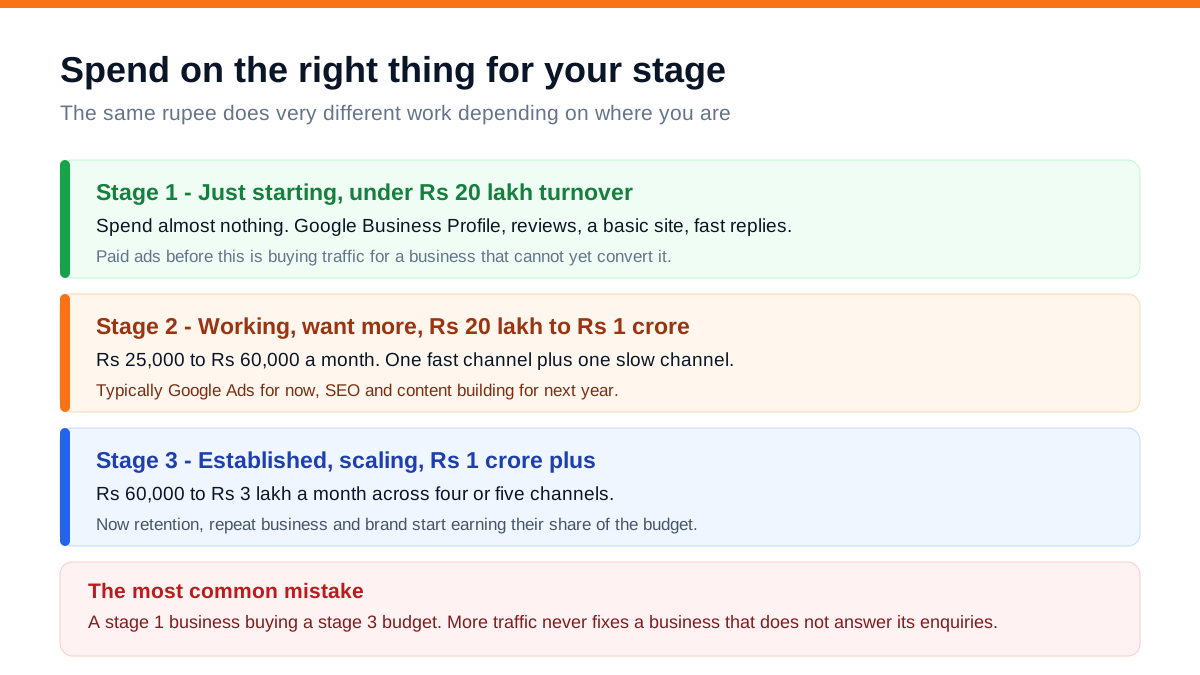
Stage 1 - under roughly Rs 20 lakh turnover. Spend almost nothing on advertising. Complete your Google Business Profile, collect reviews, get a working website, and reply to every enquiry within the hour. These are free or cheap and they produce more than paid advertising will at this stage. Buying traffic for a business that cannot yet convert it is the most common way small businesses conclude that marketing does not work.
Stage 2 - roughly Rs 20 lakh to Rs 1 crore. Rs 25,000 to Rs 60,000 a month is a realistic band. Run one fast channel and one slow channel: typically Google Ads for enquiries now, and SEO or content building for next year. This combination is what stops a business being permanently dependent on rented traffic.
Stage 3 - Rs 1 crore and above. Rs 60,000 to Rs 3 lakh a month across four or five channels, and now retention and repeat business deserve real budget rather than being an afterthought. At this stage the cheapest growth is usually from customers you already have.
The point is not the exact figures, which vary hugely by industry. It is that stages have different bottlenecks, and spending on the wrong bottleneck is wasted regardless of amount.
The 70-20-10 split
Once you have a number, the next question is how to divide it. This split works well and stops two common failure modes - putting everything into one channel, and spreading so thin that nothing gets a fair test.
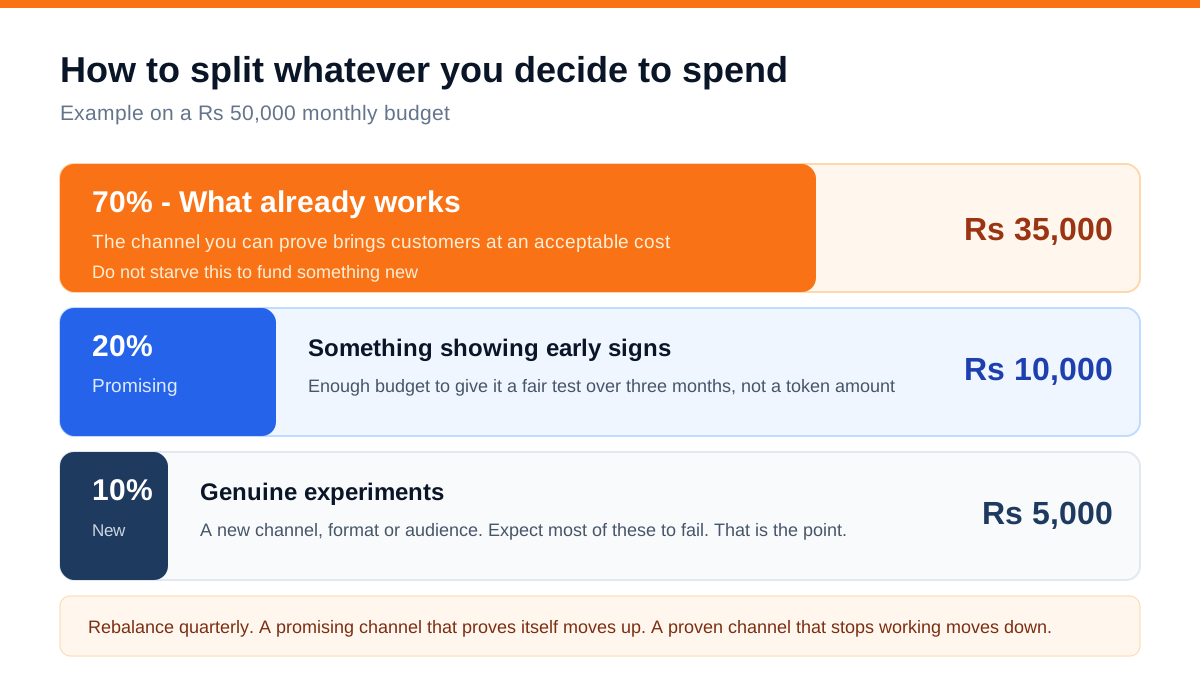
70% on what already works. The channel you can prove brings customers at an acceptable cost. Do not starve this to fund something new and exciting - it is paying the bills.
20% on something promising. A channel showing early signs but not yet proven. Crucially, this must be enough budget to give it a fair three-month test. Rs 2,000 a month spread across a new channel proves nothing and wastes the money entirely.
10% on genuine experiments. A new format, audience or platform. Expect most to fail. That is the function of this slice - it is how you find the next channel before the current one gets expensive.
Rebalance quarterly. A promising channel that proves itself moves into the 70%. A proven channel whose cost per customer has been climbing for two quarters moves down.
If you are entirely new to paid advertising and unsure how to divide even the first slice, our comparison of Meta Ads and Google Ads sets out where each fits.
Budget for the timeline, not the month
The most damaging budgeting error is committing monthly to something that only works over quarters.
Different channels have completely different payback periods. Google Business Profile pays back in weeks. Google Ads in one to three months. Social in three to six. SEO in six to twelve. Content marketing in nine to eighteen.
This has two direct budgeting consequences:
Commit for the channel's timeline or do not start it. Three months minimum for any paid channel, nine for SEO or content. A business that funds SEO for four months and stops has bought the slow part and left before the payoff - it would genuinely have been better not to start.
Never spend money you need back this month. Marketing budgets under that pressure get switched off in week three, which guarantees a loss. If cash flow is tight, spend less for longer rather than more for a short burst.
A practical way to hold this: set the budget as an annual figure divided by twelve, and treat the monthly number as a drawdown rather than a decision to remake each month.
The costs people forget to budget
Quoted service fees are rarely the whole cost. These get missed almost every time:
- Ad spend is separate from management fees. An agency charging Rs 15,000 to manage Google Ads is not including the Rs 30,000 you pay Google. Confirm which is which before signing anything
- Your own time. Approvals, content, photographs, calls. Several hours a week, and it is a real cost
- Creative production. Photography, video, graphics. Recurring, not one-off
- Website hosting and maintenance - Rs 8,000 to Rs 30,000 a year
- Tools - email platform, scheduling, analytics, CRM. Individually small, collectively noticeable
- The landing page or site fix that the campaign needs to work at all. This is frequently discovered after the campaign starts and blamed on the campaign
- Sales capacity to handle the enquiries. If marketing works and nobody can answer the phone, you have paid for enquiries you then lose
Add fifteen to twenty percent to whatever you first calculate. That is roughly what these come to for most small businesses.
When to increase, hold or cut
Review quarterly, per channel. Aggregate numbers hide everything that matters.
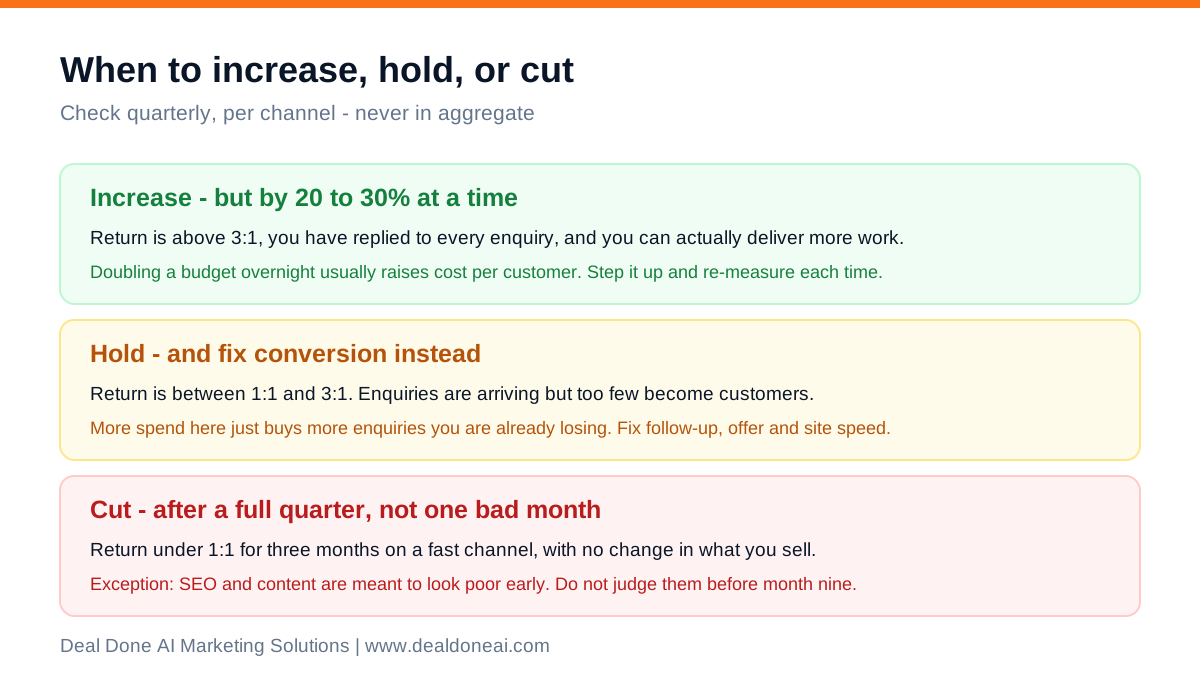
Increase when return is above 3:1, you are replying to every enquiry, and you can actually deliver more work. Raise by 20 to 30% at a time and re-measure - doubling a budget overnight almost always raises cost per customer, because you move beyond your best audience.
Hold and fix conversion when return is between 1:1 and 3:1. Enquiries are arriving and too few are converting. More spend here buys more enquiries you are already losing. Fix follow-up speed, the offer, and site speed first; these typically improve returns more than any budget increase would.
Cut when return is under 1:1 for a full quarter on a fast channel with no change in what you sell. One bad month is not a signal. And the exception matters: SEO and content are supposed to look poor early, so judging them before month nine will make you cut the cheapest leads you were ever going to have.
One more rule that saves money: if you cannot measure a channel, you cannot budget for it. Get tracking working before you increase spend, not after.
In-house, freelancer or agency
This decision changes the shape of the budget more than the amount.
Doing it yourself costs no cash and considerable time. Reasonable for the first few months, and genuinely valuable - you learn what your customers respond to, which makes you a far better client later. It stops being reasonable when the opportunity cost of your hours exceeds what you would pay someone.
A freelancer is the cheapest paid option and works well for a single defined channel. The risks are availability and continuity: freelancers get busy, take other clients, and occasionally disappear. Fine for execution, weaker for strategy.
An agency costs more and buys breadth - strategy, multiple channels, cover when someone is unavailable, and accountability. Worth it once you are running more than two channels or spending enough that mistakes are expensive.
An in-house hire makes sense at scale, typically once you are spending upwards of Rs 1.5 lakh a month, where the salary is a smaller share than agency fees would be.
Whichever you choose, insist on the same reporting: cost per enquiry and cost per customer, by channel, monthly. If a provider reports impressions and reach and cannot state your cost per customer, you cannot manage the budget regardless of what you are paying.
Budgeting mistakes that waste money
- Spreading too thin. Rs 5,000 each across six channels proves nothing about any of them. Two channels funded properly beats six funded token amounts
- Stopping and starting. Three months on, two months off. Every restart loses the learning and, in paid advertising, resets the optimisation
- Budgeting for ads while the website cannot convert. The most expensive sequencing error. Fix the site first; it lowers cost per customer on every channel simultaneously
- No budget for creative. Running the same three images for a year and blaming the platform when performance declines
- Confusing seasonal with structural. Many Indian businesses have genuine seasons. Budget higher in season and lower out of it, rather than treating a quiet month as a failure
- Ignoring retention entirely. Almost every small business we work with could raise profit faster by spending on existing customers than on new ones, and almost none of them budget for it
A worked example: building a budget from scratch
A modular kitchen business in a tier-2 city. Average order Rs 1,45,000, gross margin about 32%, so roughly Rs 46,000 margin per customer. They convert about one in five enquiries. They want six additional customers a month.
The calculation. Six customers needs 30 enquiries. They had no historical data, so we started with a cautious estimate of Rs 900 per enquiry for this category, giving roughly Rs 27,000 a month. Adding 18% for creative, tools and the landing page work gave a working budget of about Rs 32,000.
The sanity check. Six customers is Rs 2,76,000 of gross margin against Rs 32,000 of spend. Comfortable, with room for the estimate to be wrong by a factor of two.
The split. They had nothing proven, so the 70-20-10 rule did not apply in month one. We put Rs 22,000 into Google Ads as the fast channel, Rs 10,000 into SEO as the slow one, and committed to nine months on the SEO before judging it.
What actually happened. Quarter one produced enquiries at Rs 1,340 - well above the estimate - and only 3.2 customers a month. Rather than increasing the budget, we looked at conversion: enquiries arriving after 7pm were being answered the next afternoon, and the quote took four days to reach the customer. Fixing both took two weeks and no money.
Quarter two, on the identical Rs 32,000, produced 7.1 customers a month at an enquiry cost of Rs 1,180. Quarter three, with SEO starting to contribute, produced 9.4 customers. Only then did we increase the budget, by 25%, to Rs 40,000.
The budget was never the constraint. The constraint was how quickly somebody replied, and increasing spend in quarter one would have bought more of the same loss.
Before increasing a marketing budget, find out what happens to the enquiries you are already paying for. That answer is usually cheaper than the increase.
Frequently asked questions
How much should a small business in India spend on digital marketing?
Work backwards rather than using a percentage: customers wanted, divided by your enquiry-to-customer rate, multiplied by your cost per enquiry. As rough bands, a business under Rs 20 lakh turnover should spend very little beyond free channels, Rs 20 lakh to Rs 1 crore typically supports Rs 25,000 to Rs 60,000 a month, and above Rs 1 crore usually runs Rs 60,000 to Rs 3 lakh a month.
Is a percentage of revenue a good way to set a marketing budget?
It is a reasonable upper limit but a poor decision rule, because it ignores your margin, what a customer is worth to you, and whether the spend is producing anything. Two businesses with identical revenue and different margins cannot afford the same budget. Calculate from customer targets and customer value instead.
How should I split my budget between channels?
Roughly 70% on the channel you can prove works, 20% on one that looks promising and deserves a fair three-month test, and 10% on genuine experiments. If nothing is proven yet, start with one fast channel such as Google Ads and one slow channel such as SEO, and rebalance quarterly once you have data.
How long should I commit a budget before judging it?
Three months minimum for any paid channel, and nine months for SEO or content marketing. Judging a slow channel on a fast channel's timeline is the most common reason businesses cut the thing that was about to work. If you cannot commit to the timeline, it is better not to start that channel at all.
When should I increase my marketing budget?
When the return is above 3:1, every enquiry is being answered promptly, and you have the capacity to deliver more work. Increase by 20 to 30% and re-measure before increasing again. Doubling suddenly usually raises your cost per customer because you expand beyond your best-performing audience.
Should I hire an agency or do it myself?
Do it yourself for the first few months regardless of your eventual plan - you learn what your customers respond to and become a far better client. Move to a freelancer for a single channel, or an agency once you are running several channels or spending enough that mistakes get costly. Consider an in-house hire above roughly Rs 1.5 lakh a month of spend.
Where to start
Do the five-step calculation this week. Customers wanted, conversion rate, cost per enquiry, multiply, sanity-check against margin. Twenty minutes, and you will have a number you can justify rather than one someone quoted you.
If step three stops you because you do not know your cost per enquiry, that is your project for the next quarter - spend a modest amount deliberately to find out, and treat the answer as the real deliverable.
Our packages list what our own services cost so you can plug real figures into the calculation rather than estimates, and our lead generation and SEO pages set out what each involves. If you want help building the budget itself, tell us your customer target and what a customer is worth to you and we will work it through with you.